OCP Global Summit 2026#
October 12, 2026 – October 15, 2026 Program
Core#
Co-Designing AI Fabrics: Inside Google's Virgo Network and the Campus-as-a-Computer#
Sunil Ahluwalia (Google), JK Lee (Google)

- Why: One of the few public looks inside Google's AI fabric — the architectural shift from "data center as a set of servers" to campus-scale supercomputer is the defining physical-networking problem of this cycle, and Google is unusually specific here about the transport and telemetry mechanisms.
- What: Virgo, a megascale multi-plane AI datacenter fabric running open-source SONiC, built for synchronized-burst ML traffic with a stated value proposition of predictable low latency and maximized "goodput" (from abstract only).
- How: Open-source RDMA transport (Falcon), Congestion Signaling (CSIG), and High-Speed Telemetry (HST), on a multi-plane architecture over open standards and merchant hardware ecosystems.
- Where applicable: Google-specific production design, but the constituent technologies (CSIG, HST, Falcon) are being pushed into SONiC/open ecosystems — see the Google SONiC CSIG/HST talk below, which is the deployable version of this story.
MetaRoCE: Rethinking RDMA for the AI presented by Meta#
Arvind Srinivasan (Meta), Sandeep Nagaraja (Meta), Balakrishnan Raman (AMD)
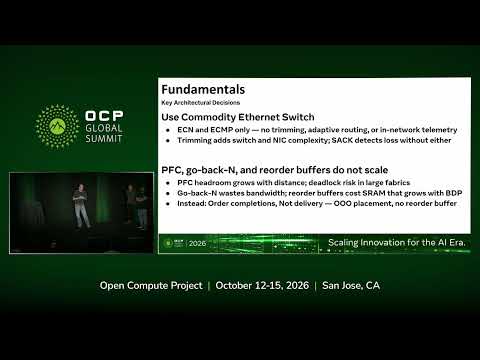
- Why: A clean-sheet replacement for RoCEv2 from one of the largest GPU-fleet operators, now being opened as a spec — directly in the PM's lossless-fabrics/RDMA core interest and a candidate competitor/complement to MRC (below).
- What: MetaRoCE, a multipath, out-of-order, receiver-driven RDMA transport that treats Ethernet as lossy by design rather than patching lossless fabrics with more tuning; Meta is publishing the specification for industry adoption (from abstract only).
- How: All transport intelligence is pushed into the NIC; multipath and receiver-driven delivery replace PFC-style losslessness as the reliability model.
- Why it matters for triage: Paired with MRC and SUE-T, this is the third open transport spec from a hyperscaler this cycle — the field's verdict that decade-old RoCEv2 is done at 10k+ GPU scale.
- Where applicable: Meta production (tens of thousands of GPUs); AMD co-presenting suggests NIC-side implementation requirements — adoption depends on NIC vendor support, so watch the ecosystem response.
Enabling AI Networking @ Scale with Multi-path Reliable Connections (MRC)#
Guohan Lu (OpenAI), Eric Spada (Broadcom Inc.)
- Why: MRC is now a ratified OCP specification co-authored by OpenAI and Broadcom — a concrete, open alternative for AI-fabric transport that a PM in this space will need to track against MetaRoCE and Falcon.
- What: MRC combines multipath transport, adaptive load balancing, reliable delivery, and path-aware congestion management to keep utilization high and tail latency low in fabrics of hundreds of thousands of XPUs (from abstract only).
- How: Multipath reliable connections at the transport layer with awareness of per-path congestion state; the OCP MRC 1.0 document is the spec itself, which the session walks through.
- Where applicable: Designed for open Ethernet-based AI infrastructure broadly, not one operator's fabric; requires switch/NIC support for the MRC semantics (Broadcom involvement signals merchant-silicon intent).
ESUN: Open Ethernet for the AI Scale-Up Era#
Pratik Marolia (Microsoft), Manoj Wadekar (Meta)
- Why: Scale-up (in-rack/in-pod XPU interconnect) was the last proprietary holdout — NVLink territory. ESUN 1.0, ratified by OCP in March 2026 with 170+ contributors from 20+ organizations including NVIDIA itself, is the strongest signal yet that open Ethernet is expanding from scale-out into scale-up.
- What: An operator-requirements specification for Ethernet-based scale-up networks: minimizing header/framing overhead designed for general internet traffic, and breaking single-vendor interconnect lock-in (from abstract only).
- How: Cross-industry coalition (Meta, Microsoft, AMD, Arista, Broadcom, Cisco, Marvell, NVIDIA, OpenAI, Oracle) producing an OCP spec in months; the talk covers the what and the roadmap for future versions.
- Where applicable: Industry-wide; it is a requirements/spec document, so its impact depends on silicon (Tomahawk-class and similar) implementing it — pair with the SUE-T and Tahan talks for the transport and hardware instantiations.
SUE-T - An Ethernet transport for Scale-Up Networking#
Tom Emmons (Arista Networks), Karen Schramm (Broadcom)

- Why: ESUN defines the network requirements; SUE-T defines what actually rides on it — the semantics of moving memory transactions between XPUs over Ethernet. This is the layer where scale-up Ethernet becomes a real RDMA-class competitor.
- What: The Scale-up Ethernet Transport framework: low-latency, high-bandwidth connectivity where a SUE-T instance moves memory transactions between XPUs across rack/multi-rack clusters (from abstract only).
- How: An Ethernet-based transport protocol suitable for deployment over ESUN-defined networks; the session walks the specification and how it meets scale-up's latency and bandwidth demands for next-gen XPU designs.
- Where applicable: General technique (open spec, not operator-specific), but requires XPU and switch support for the transport; relevant to anyone evaluating open alternatives to proprietary scale-up fabrics.
Tahan: An Open, Ethernet-Based Scale-Up Switch for Meta's MTIA Accelerators#
Ashutosh Grewal (Meta), Vimal Vasudevan (Meta Platforms inc.)

- Why: The best "show me the hardware" talk on scale-up Ethernet: a first-generation open scale-up switch with real numbers, and a rare case of one NOS (FBOSS) and one transport (RoCE) spanning both scale-out and scale-up.
- What: Tahan, Meta's first scale-up switch for MTIA 300 accelerators: 6.4 Tbps per accelerator over 8× 800GbE passive copper links, 16 accelerators per liquid-cooled rack interconnected via 4 switches in a non-blocking topology, on merchant 25T/51.2 Tbps silicon running FBOSS (from abstract only).
- How: Reuses the scale-out network's lossless RoCE transport (routed IPv6, PFC, AI-tuned QoS) on the scale-up fabric, eliminating separate software stacks and operational silos; next-gen targets 8 switches on 102.4 Tbps silicon, 72 accelerators per rack, adopting OCP ESUN as the dataplane.
- Where applicable: Meta-specific (MTIA, FBOSS, in-rack passive copper reach), but the architecture pattern — unifying scale-up/scale-out under one Ethernet transport and NOS — is broadly instructive; note the passive-copper choice constrains it to in-rack distances.
Meta 102.4T Ethernet Switch#
Rongchun Zhou (Meta), Reza Niazmand (Meta)

- Why: The switch platform that much of Meta's next-gen AI fabric story runs on — a concrete OCP hardware contribution on the newest merchant silicon, directly in the PM's physical switching interest.
- What: IceCube, a 102.4T non-blocking Ethernet switch on the Broadcom TH6C ASIC running FBOSS: 2OU form factor, 64× OSFP-RHS user ports, liquid-cooled; IecPack is an ORv3-HPRv1 rack integrating eight IceCube blades plus servicing equipment for versatile switch roles (from abstract only).
- How: Standard OCP open-hardware contribution model — merchant silicon + open NOS + open rack; engineering focus is reliability, power efficiency, and NPI velocity.
- Where applicable: Meta-specific platform but fully OCP-documented; requires TH6C-class silicon and liquid-cooled racks. Pair with the integrated-optics talk for where this platform line is heading optically.
Integrated Optics at Scale for AI Infrastructure: From 51.2T CPO Validation to Meta's 102.4T Integrated Optics Switch#
Granthana Rangaswamy (Meta), Siamak Amiralizadeh (Meta), Xu Wang (Meta Platforms, Inc.)

- Why: The strongest quantified case at this conference for integrated optics over pluggables — real power and reach numbers from a platform moving from 51.2T validation into a 102.4T product, at the exact 200G/lane inflection point where pluggables struggle.
- What: A 1.5OU, 100% liquid-cooled, fanless blade with 64 optical ports via 16 four-port MMC interfaces and 16 ELSFP external-laser modules, delivering ~60% optics power reduction, ~30% system power reduction, and 500m reach versus pluggables (from abstract only).
- How: Optical engines placed on (CPO) or near (NPO) the ASIC substrate, eliminating pluggables; decoupling the laser lifecycle from the ASIC via ELSFP external lasers; fanless liquid cooling to reduce fiber contamination risk.
- Where applicable: Meta platform, but the power/reach trade-offs and the laser-decoupling architecture are broadly applicable to any operator weighing CPO/NPO at 102.4T; built on prior-generation 51.2T validation, so the numbers have production lineage.
Operating Linear Pluggable Optics at Hyperscale: From Link Management to Production Reliability#
Amin Yekani (Meta), Qing Wang (Meta)

- Why: LPO removes the DSP and shifts equalization to the host ASIC — an architecture any PM evaluating power-vs-reliability in optical links must judge. This is one of the few talks with fleet-scale production data rather than lab claims.
- What: Meta's operational experience with LPO across link management, link-health monitoring, and production results: a large-scale live-traffic deployment with tens of millions of accumulated link-hours, including failure-rate, signal-quality, power, and thermal measurements (from abstract only).
- How: Host- and module-side signal conditioning maintained fleet-wide (since no DSP auto-adapts), plus multi-layer monitoring covering signal quality, error metrics, and early detection of lane-level degradation.
- Where applicable: Explicitly framed as applicable to any DSP-free optical architecture; the operational framework (not just the modules) is the transferable artifact. Constrained by host-ASIC equalization capability — not a drop-in for any switch.
Lessons learned from GW-scale AI deployments#
Mark Filer (Oracle)

- Why: An end-user case study with production statistics on one of the world's largest 800G 2xDR4 LPO deployments — exactly the real-numbers, real-failure-mode content this PM values over vendor demos.
- What: Hard-won operational learnings from OCI's deployments supporting top AI customers at 10,000+ GPU scale, where single link flaps stall multi-million-dollar training jobs; includes production statistics on the LPO deployment and how the experience translates to 1.6T (from abstract only).
- How: Operational discipline at "laws of large numbers" scale — treating per-link instability as the primary availability adversary, with forward-looking paths to uptime/resilience in massive distributed systems.
- Where applicable: OCI-specific production data, but the failure-mode taxonomy and the 800G→1.6T extrapolation are relevant to any operator of GPU backbones; pairs naturally with the LPO talk above as the customer-side view.
Large-Scale Deployment of 800Gb/s Active Electrical Cables (AEC) in Meta Data Centers for AI Applications#
Jingyu Yu (Meta), Abhijit Chakravarty (Meta)

- Why: Cabling is a first-order cost/power lever in AI clusters and rarely gets a full methodology talk; this covers multi-vendor qualification to volume production, which is the hard part.
- What: Meta's qualification, validation, and deployment methodology for 800 Gb/s AECs (112 Gb/s/lane) in large-scale GPU clusters, spanning component characterization, environmental reliability, multi-vendor interoperability, system-level traffic validation, and manufacturing readiness across multiple suppliers and production sites (from abstract only).
- How: Lab plus in-cluster validation of link stability, packet integrity, latency, and firmware compatibility; the program resolved signal-integrity, manufacturing-consistency, and firmware-interoperability issues to reach multi-sourced volume adoption.
- Where applicable: Meta AI clusters but the qualification framework is general; AECs apply to short-reach in-cluster interconnect (rack-to-rack distances), as a power- and cost-efficient alternative to optics and passive DAC at 800G.
Srv6 powered backbone networks#
Jasmeet Bagga (Facebook), Andrey Golovanov (Meta)
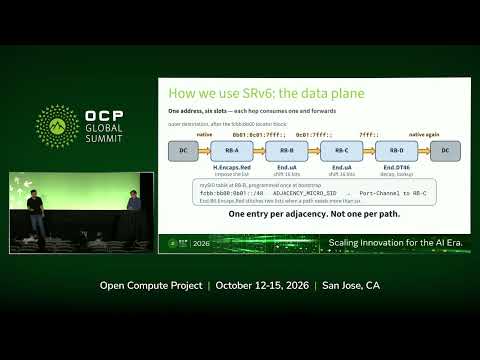
- Why: Meta WAN/backbone architecture is squarely in the PM's DC/WAN-interconnect core interest, and this is an unusually internals-heavy talk: SRv6 for traffic engineering, shallow-buffer switches for long-haul, and real SAI/FBOSS experience.
- What: RBB (Regional Backbone), a newly designed inter-region connectivity network running in parallel to Meta's express backbone (EBB), motivated by the cost of replicating latency-sensitive core services into every region as region count grows (from abstract only).
- How: Traffic-engineered SRv6 over shallow-buffer switches for long-haul backbone links — a counterintuitive choice the talk explains — with SRv6 SAI support and deployment experience on FBOSS OCP switches.
- Where applicable: Meta-specific WAN, but the design pattern (parallel TE'd backbone with SRv6, shallow buffers for long-haul) and the SAI/SRv6 standardization feedback are broadly relevant to multi-region operators.
Traffic Engineering in AI DCI/WAN for AI Traffic#
Yuanchao SU (Alibaba Cloud), Clarence Filsfils (Cisco)

- Why: Geo-distributed AI training is now the driving WAN workload; this pairs the SRv6 inventor with a hyperscaler that has actually deployed it, covering both the problem framing and two real deployments.
- What: The traffic-engineering problem and requirements for AI DCI/WAN connecting geographically distributed training data centers — how it was solved for legacy non-AI traffic, why that solution falls short for synchronized, elephant-heavy AI flows, and the AI-specific solution including the data and telemetry collection needed to drive it (from abstract only).
- How: TE over the WAN for AI job traffic (presumably SRv6-based given the co-author); the abstract emphasizes required telemetry and two real deployment case studies rather than architecture alone.
- Where applicable: Alibaba Cloud production deployments — org-specific specifics expected; the requirement analysis (bursty synchronized traffic over constrained DCI) generalizes to any multi-DC training operator. Pairs with the scale-across panel below.
Clustermapper: Deterministic path diagnosis for AI backend networks using SRv6#
Ryder Lewis (OpenAI), Guohan Lu (OpenAI)
- Why: Turns path diagnosis from statistical inference into ground truth — a genuinely clever use of SRv6 source routing, and the operational companion to the MRC spec from the same OpenAI team.
- What: A path-diagnosis system for MRC/SRv6 AI backend networks: a lightweight agent on every node sends SRv6 source-routed self-probes through T0/T1 switch paths, producing a deterministic link-health map used to localize faults (NIC-T0 links, T0-T1 links, switch forwarding) and turn urgent link-failure incidents into scheduled maintenance (from abstract only; the linked arXiv paper — titled "Resilient AI Supercomputer Networking using MRC and SRv6", 18 pages, 22 figures — was not retrievable beyond its landing page).
- How: SRv6 deterministic source routing pins each probe to an exact path, eliminating ECMP ambiguity and routing-convergence noise so failures localize to specific links even between training jobs; output feeds path-avoidance policy for MRC.
- Where applicable: Requires SRv6 (and works best with MRC) in the backend network — OpenAI production, but the technique is general to any SRv6 fabric and notably valuable for small network teams operating huge clusters.
Beyond Traditional BGP: Decoupling Route Distribution for Large-Scale AI Clusters at Alibaba#
Eddie Ruan (Alibaba), Dennis Cai (Alibaba)

- Why: Directly in the PM's BGP/datapath-internals interest: a concrete alternative to Microsoft's Fairwater host-SRv6 approach for AI-cluster routing scale, from a provider that can't mandate host-side changes — a real architectural debate with numbers attached.
- What: An architectural decoupling of service route distribution from infrastructure route distribution: regular BGP continues to carry infrastructure routes within spine/leaf, while service routes are redistributed among leaf switches by multiple route reflectors, recursively resolved over the loopback of the anchoring leaf switch (from abstract only).
- How: A "Group RR" concept coordinates multiple RRs to provide Graceful Restart capability and high availability for critical service prefixes, so service routes survive RR cluster outages; positioned explicitly against Fairwater's <1,000-route / 256-way-ECMP host-SRv6 model from OCP 2025.
- Where applicable: Alibaba-specific architecture for multi-tenant clouds that cannot impose host changes — broadly applicable to any provider facing the same constraint; BGP-only, no host or silicon requirements.
6–12x Route Programming Acceleration in SONiC: A Collaborative Profiling and Optimization Journey#
Deepak Singhal (Microsoft), Amol Rawal (Nokia)
- Why: Contributor-led SONiC internals with hard numbers (2K–4K routes/sec baseline → 6–12x), a reproducible benchmarking methodology, and upstreamed code — the archetype of a talk that reveals where an open-source project is actually heading.
- What: A joint Microsoft–Nokia effort that built a Snappi-based benchmarking framework, profiled existing optimization proposals and their combinations across multiple hardware platforms, then contributed fresh optimizations: replacing Redis-based IPC with direct ZMQ communication, offloading synchronous recording from the hot path, and integrating tcmalloc into FRR daemons (from abstract only).
- How: Measurement-first — the framework identifies which optimizations actually matter and how they interact, rather than merging proposals blindly; results were driven through SONiC Routing Working Group consensus with published HLDs across multiple sonic-net repositories.
- Where applicable: SONiC on any supported platform (multi-platform profiling included); most relevant to fabrics pushing 1M+ route scale, e.g. large AI clusters with heavy ECMP.
Software-Assisted Congestion Signaling and Sub-Millisecond Telemetry in SONiC#
Arpitha Raghunandan (Google), Shane Gao (Google)

- Why: The deployable half of the Virgo story: how Google gets microsecond-scale telemetry and per-packet congestion signaling into SONiC — and, crucially, onto older ASICs that don't support it in hardware.
- What: A SONiC architecture proven at Google scale with two components: HST (High-Speed Switch Telemetry) — lightweight digests and high-resolution traces enabling microsecond-scale per-device profiling — and CSIG (Software-Assisted Congestion Signaling), which updates packet signals with real-time switch state to give end hosts high-frequency per-packet telemetry (from abstract only).
- How: Sub-millisecond runtime write-backs of per-port metrics via the HST framework, and reuse of unused match-action table resources in the ASIC pipeline to implement custom signal types the hardware doesn't natively support — enabling CSIG on existing networks with older silicon.
- Where applicable: Google-proven but designed for upstream SONiC; the "software-assisted on older ASICs" angle makes this broadly applicable to brownfield fabrics, not just new AI builds.
Open, Trusted, and Secure SONiC at Scale presented by Cisco#
Will Eatherton (Cisco), Dina Papagiannaki (Microsoft)

- Why: SONiC security posture is becoming an adoption gate as it moves into enterprise and AI infrastructure, and this lays out an end-to-end framework — FIPS, attestation, and eBPF-based live patching — that touches the PM's security and eBPF interests directly.
- What: An end-to-end SONiC security framework spanning supply-chain integrity, verified software authenticity, secure build pipelines, FIPS-ready hardware with a platform root of trust, confidential networking (protecting data and network state), and Day-2 monitoring with integrated CVE intelligence (from abstract only).
- How: eBPF-based runtime protections enable rapid mitigation and live patching without reboots — protect immediately, apply permanent patches in a planned window, revalidate; hardware/firmware/software integrity validated across the system lifecycle.
- Where applicable: General SONiC security architecture rather than a single deployment; note this is a vendor-led expo-hall session, so expect framework-level content without deployment metrics — the eBPF live-patch workflow is the concrete piece to take away.
An Introduction to Attesting Hitlessly Updatable Systems#
Matt King (NVIDIA)

- Why: A sharp conceptual contribution to the PM's identity/attestation interest: hitless firmware updates break the standard attestation model, because the platform can change between evidence production and relying-party use.
- What: An analysis of what attestation must become for platforms that update firmware while tenant workloads run: conventional measurements of the TCB that has run are insufficient; the relying party must also assess whether future updates could compromise the properties it depends on (from abstract only).
- How: Combine three evidence classes — current TCB measurements, the history of prior updates, and the policy governing future updates — so a relying party can make an informed decision about a system that changes while it runs.
- Where applicable: General technique for any attested platform doing hitless updates (switches, NICs, BMCs, accelerators); an introductory/conceptual talk, but it defines the problem shape the DMTF/OCP attestation work will have to address. Pairs with the SPDM provisioning talk below.
OCP Device Identity Provisioning over SPDM#
Fabrizio Damato (AMD), Xiaoyu Ruan (Intel)

- Why: Directly in the PM's workload-identity core interest at the hardware layer: operator/tenant-owned PKI enrollment for fleet devices, standardized over SPDM instead of per-vendor proprietary flows.
- What: The OCP Device Identity Provisioning specification: an Attested CSR that cryptographically binds a newly generated device keypair to the device's attested identity and measured state, plus a keypair-discovery flow so enrollment authorities can enumerate the identity keys a device exposes (from abstract only).
- How: Flows currently ride on SPDM vendor-defined messages for early deployment, while OCP drives the capability into DMTF SPDM (anticipated in SPDM 1.5); open-source RoTs such as Caliptra are expected to adopt it.
- Where applicable: Broadly applicable — this is a standardization talk, not an operator case study; the constraint is that full benefit requires RoT/BIOS support (Caliptra adoption is the open-source path) and SPDM-capable devices.
Scale-across Networking: Panel discussion on routing and transport equipment implications#
Jeff Rahn (Meta), Yawei Yin (Microsoft), Xiguang - Henry Wu (Broadcom), Tad Hofmeister (Google)
- Why: The PM's DC/WAN interconnect territory: with power and space capping single-site clusters, operators are extending AI fabrics across metro/regional distances to reach 0.5M–1M XPUs — a problem that diverges sharply from conventional cloud DCI.
- What: A multi-operator panel (Meta, Microsoft, Google, Broadcom, with Arista referenced) on the scale-across use case: real-world rollout experience and the architectures being built for clusters beyond 100k XPUs, where propagation delay, higher oversubscription, and massive synchronized bursts change the equipment requirements (from abstract only).
- How: Panel focuses on concrete technology implications: coherent pluggables (ZR/ZR+) to overcome fiber scarcity, deep packet buffering to absorb regional latency, wire-rate security, and advanced congestion control.
- Where applicable: Multi-operator (not single-vendor) and forward-looking — panel format means less depth per topic, but it is the best cross-industry read on where AI DCI equipment requirements are heading. Pair with the Alibaba AI DCI/WAN TE talk for the deployment-level counterpart.
Adjacent#
Achieving AI Cluster Reliability at Scale: Lessons in Reducing Workload Interruptions#
Bob Wang (Meta), Ramachandra Reddy Kallam (Meta)

- Why: Not a networking talk per se, but network events are one of the correlated signals — and the root-cause methodology (attributing every interruption across host, firmware, network, and workload telemetry) is reusable by anyone operating large fabrics.
- What: A framework for diagnosing AI workload interruptions at 32K→100K+ GPU scale, built on root-cause classification via Perfetto time trees correlating host telemetry, firmware logs, network events, and workload signals; key contributors include NVLink failures, HBM fragmentation, thermal failures, silent data corruption (SDC), and firmware bugs (from abstract only).
- How: Data-driven root-cause analysis feeds back into next-gen hardware requirements, including vendor decisions on error reporting, fault isolation, and resilience; the diagnostic framework is being offered to the broader OCP community.
- Where applicable: Meta GBx00 clusters — org-specific failure data, but the methodology (correlated time-tree attribution) and the hardware-requirements feedback loop generalize well.
Wildcard#
From Fleet to Firmware: Bringing AI-Native Security to Open Hardware with Project Equilibrium presented by Google#
Andres Lagar-Cavilla (Google)

- Why: AI turned on the systems that run AI — a genuinely novel direction: autonomous, continuous security for open-source firmware that outpaces what periodic audits and static scanning can do as frontier models accelerate vulnerability discovery.
- What: Google's Project Equilibrium, an AI-native security architecture pairing live, repo-colocated threat models with autonomous pre-submit scanning and automated patching — catching deep bugs and cutting false positives before merge — plus a path to extend the workflow from fleets to bare-metal firmware via open security cookbooks (from abstract only).
- How: Threat models live next to the code they describe; autonomous pre-submit analysis and patching run against the millions of lines of low-level code in OpenBMC, Caliptra, CXL, and NVMe.
- Where applicable: Open-hardware ecosystem broadly (cookbooks are explicitly meant as a shared baseline); currently a Google internal capability being externalized, so treat maturity accordingly — but for anyone whose supply chain includes open firmware, this is where the field is heading.
Mitigating AI Training Power Oscillations: Utility Requirements and In-Rack Power Filtering#
Bo Wen (Microsoft), Xianyong Feng (Microsoft)

- Why: A surprising cross-domain result: synchronized GPU compute/communication phase transitions at cluster scale overlap with sensitive utility-grid frequency bands, creating forced-oscillation and impedance-stability risks — power design is becoming a networking-adjacent constraint on cluster architecture.
- What: A framework connecting grid-side power-transient requirements (power-change and oscillation limits, ramp-rate expectations, synchronized monitoring from utility interconnect down to rack level) with practical in-rack mitigation, including PSU + CBU filtering concepts, frequency-sweep test methods, attenuation analysis, and verification results (from abstract only).
- How: Rack-level buffering (PSU plus CBU) measurably reduces upstream power ripple; measurement and modeling align AI rack power design with utility requirements.
- Where applicable: Relevant to any operator at multi-hundred-MW AI scale interacting with utilities; Microsoft-specific verification data, but the utility constraints are universal for large campuses.
Clock-Aligned Telemetry for AI Clusters: From BMC to GPU to Fleet#
Ahmad Byagowi (TBD), Lukas Landgraf (turbalance)

- Why: The observability gap this addresses — many dashboards, no common evidence model — sits exactly at the junction of the PM's telemetry and Kubernetes/eBPF interests, and clock alignment as the basis for cross-machine trust is an idea worth stealing.
- What: A lab-built reference architecture for clock-aligned AI telemetry: a source-bundle contract, live agents, a conservative benchmark ladder, a Redfish/BMC lane, and a lakehouse path that preserves provenance and never synthesizes unsupported metrics; links DCGM/NVML, host counters, Prometheus, Kubernetes, Redfish, eBPF/OTel evidence, and PTP/NTP clock state (from abstract only).
- How: Per-datacenter ingestion without global shared state feeds one Iceberg layer over cold and fresh stores; a six-level benchmark ladder (metric to global baseline), auto-discovery, credential-gated agents, 1s freshness, and capability labels — PTP/NTP state as a first-class signal changes what cross-machine comparison can be trusted.
- Where applicable: Prototyped on a heterogeneous lab fleet (not hyperscale production yet), with an open-source repo and a proposed OCP collaboration path — early-stage, which is exactly why it's a wildcard rather than core.
Themes#
- Ethernet is eating the AI cluster bottom-up: with ESUN (operator requirements), SUE-T (memory-transaction transport), and Tahan (a real scale-up switch), open Ethernet now claims scale-up alongside scale-out — the last proprietary interconnect domain (in-rack XPU fabrics) is being standardized in the open, ratified in months with 170+ contributors.
- RoCEv2's successor wars have begun — in the open: MetaRoCE, OpenAI/Broadcom's MRC, Google's Falcon, and SUE-T are four open transport specs from hyperscalers in one cycle, all converging on multipath + receiver-driven/host-NIC intelligence and abandoning PFC-tuned losslessness as the model. Expect consolidation fights in 2026–27.
- The WAN is now part of the AI fabric: scale-across panels, Alibaba's AI DCI/WAN TE, and Meta's SRv6 RBB all treat inter-DC links as a continuation of the training fabric rather than classical DCI — coherent ZR/ZR+ pluggables, deep buffering, and TE for synchronized bursts are the new WAN requirements.
- Deterministic, microsecond-scale telemetry is the new control loop: HST/CSIG in SONiC, Clustermapper's SRv6 ground-truth probing, and clock-aligned evidence models share one thesis — statistical inference is being replaced by deterministic measurement as the basis for diagnosis and congestion control.
- SONiC is maturing on three axes at once: performance (6–12x route programming via ZMQ/tcmalloc, upstreamed), portability (software-assisted CSIG on older ASICs), and trustworthiness (FIPS, attestation, eBPF live patching) — it is consolidating its position as the open NOS for AI-era fabrics.
- The physical layer is being decided empirically: LPO fleet-hours, AEC multi-vendor production data, CPO power deltas, and Oracle's 800G→1.6T field experience mean optics and cabling choices are now driven by measured failure rates and power, not vendor spec sheets — and power oscillation constraints from utilities are becoming a cluster-architecture input.
About this digest
ToFaRev picked and wrote this digest on Nebius Token Factory, from the conference's published program. A person reviewed it in a pull request before it was published. Write-ups marked "from abstract only" had no fuller source to read. Source: digests/ocp-2026.md · prompt: prompts/ocp-2026.md