NLNOG Day 2025 (Amsterdam)#
A small, single-track operator program (10 sessions, no published abstracts — all write-ups below are grounded in the extracted slide decks). Nothing here on identity, passkeys, or SPIFFE, and only one session touches cloud-native tooling; the program's center of gravity is classical operator work: optics, BGP visibility, DHCP lifecycle, and automation failure stories.
September 30, 2025 – September 30, 2025 Program
Core#
WHY 400G FTTH#
Nicola von Thadden (PFALZKOM), Arjan Koopen (i3D.net)

- Why: A rare, fully worked optical engineering case: pushing 400G over a simplex (single-strand) fiber 50 km to Amsterdam. Directly exercises the PM's physical-networking interests (coherent optics, DWDM, loss budgets, DC/WAN interconnect) with a problem most DC folk never face — no return strand.
- What: The WHY2025 hacker festival built a temporary ISP with its own AS and needed a 400G uplink from the field to Nikhef. The path used a SURF alien-wave (one 100 GHz DWDM channel) to Alkmaar, then rented duplex KPN dark fiber plus a friendly local FTTH provider's fiber — which turned out to be simplex only. The deck documents the history of camp uplinks (HAR2009 10G → SHA2017 100G coherent → MCH2022 200G → WHY2025 400G) and how they solved the simplex problem.
- How: The core finding: current coherent optics require RX and TX on the same frequency, so a standard 400G ZR transceiver cannot be split across two channels on one strand (initial ADVA tests failed; ADVA confirmed you need different product). Two escape hatches: (1) optical circulators to share one channel — works but adds attenuation/reflection risk; (2) the "cursed idea": use two separate optics, one TX-only on channel A and one RX-only on channel B, with active DWDM/OpenZR+ Smartoptics transponders in the middle because they ignore Ethernet link state ("it's a cable"). The DWDM mux doubles as the BiDi mux. The local fiber also surprised them with ~20 dB of loss over 50 km (KPN fiber behaving like 80 km).
- Where applicable: Event-specific topology (alien waves, donated strands, temporary AS), but the technique — BiDi over simplex via dual unidirectional optics or circulators, and the coherent-same-frequency constraint — transfers to anyone constrained to single-strand fiber (FTTH plant, leased simplex pairs, some campus runs). Real measured loss figures included.
Expanding Internet Routing Visibility with BMP#
Thomas Holterbach (University of Strasbourg), joint work with Thomas Alfroy and Cristel Pelsser

- Why: Two of the PM's interests converge here: BGP internals and routing-security visibility. The talk quantifies exactly what standard BGP-based collectors (RIPE RIS, RouteViews) cannot see and proposes BMP as the fix.
- What: A new next-gen route-collection platform, bgproutes.io, which inverts the priorities of RIS/RouteViews: it prioritizes coverage (percentage of ASes sharing data) over historical depth, with perpetual data retention and an open peering policy. Context: only ~1.2% of ASes share data with existing platforms; the new project got ~40 peers in ~1 year. The central technical argument: even when an operator shares data via BGP, inbound/outbound filters and the best-path decision process hide most routes ("BGP route hiding") — denied routes and backup paths are invisible, and Add-path only partially helps (and loses the per-peer mapping). BMP exposes route updates at every stage of the BGP pipeline.
- How: BMP sessions export per-peer, per-stage RIBs (
adj_in_pre,adj_in_post,local_rib,adj_out_pre,adj_out_post). Their operational recommendation: exportadj_in_preonly — one BMP session on a multi-peer router yields data equivalent to dozens of vantage points (their RGNET example: 7 BGP sessions replaced by 2 BMP sessions = 10 VPs). Onboarding is fully automated via PeeringDB login, with an opt-out list for peers you don't want to export. Data access in three forms: MRT archive (bulk), API (slices), websocket (realtime), with Python clients (pybgproutesmrt,pybgproutesapi,pybgprouteslive) that make the collection protocol transparent and also aggregate RIS and PCH data. - Where applicable: Broadly applicable — any operator with BMP-capable routers can peer (MikroTik notably lacks BMP support). The dataset is public and intended to power next-gen BGP monitoring tools; the looking-glass example in the deck is directly reusable. Academic–operator collaboration, not vendor-backed.
Collecting and analyzing routing information with Rotonda#
Luuk Hendriks (NLnet Labs)

- Why: BGP/datapath tooling the PM can adopt directly. Rotonda is the open-source engine for exactly what the previous talk argues for: ingesting BMP at scale and making it queryable.
- What: NLnet Labs' Rotonda: a routing-data collector and store that ingests BMP, live BGP, MRT dumps, and even RTR feeds; maintains RIBs per peer and per stage (pre/post policy, in/out/local); and exposes everything over an HTTP API. Example queries from the deck:
/api/v1/ribs/ipv4unicast/routes/185.49.140.0/23, with filters likefilter[ribType]=inPre(Adj-RIB-In pre-policy),filter[rovStatus]=valid(RPKI ROV status),filter[originAsn]=1133,filter[community]=AS1103:9876, plusinclude=moreSpecifics— all AND-combined. - How: The standout mechanism is Roto, a strongly-typed, compiled scripting language for filtering route data inside API queries — Roto compiles through Cranelift IR down to native x86_64/ARM64, so user-supplied filter functions run at compiled speed over stored RIBs rather than as interpreted per-route callbacks. Outputs include HTTP/JSON, MQTT, and files;
/metricsprovides Prometheus-style monitoring (the speaker candidly warns some built-in metrics are currently off and being overhauled). - Where applicable: General-purpose operator tooling, open source from NLnet Labs, deployable by anyone running BMP-capable routers — it pairs naturally with bgproutes.io-style collection and with internal route-monitoring/alerting pipelines.
The Living Source of Truth: Network Automation with Infrahub and Terraform#
Marco Martinez (Swisscom)

- Why: Network automation with a cloud-native deployment model — the closest this program comes to the PM's software-networking interests, and a realistic brownfield framing rather than a greenfield demo.
- What: A concept talk on a "living source of truth": mutable, real-time synchronization between the SOT and the actual infrastructure, instead of the classic Git/file-based desired state that drifts. The stated pain points are drift, delay, poor visibility, and manual multi-step changes across split domains (technical docs, org requirements, security policies). The stack: Infrahub as the SOT, Terraform to define/aggregate desired state, Infrahub artifacts consumed by Vidra (which applies them to a Kubernetes cluster and overwrites manual changes, keeping the cluster congruent with the SOT), and an SDC layer to push device configuration.
- How: Pipeline pattern: define desired state → aggregate desired states → create infrastructure from the data source, with each tool doing only what it does best. The deck is mostly screenshots of the Infrahub/Terraform/Vidra flow (thin on numbers), but the brownfield advice is concrete: centralize the data source, start small, fix the most time-consuming issues first, use existing tools. Goal stated as idempotent infrastructure on a reliable data source with transparency and a single pane of glass.
- Where applicable: Swisscom-scale enterprise context, but the pattern (SOT → artifacts → GitOps-style enforcement on both K8s and network devices) is broadly adoptable. Caveat: the slides are light on evaluation/results — treat this as an architecture reference, not a validated case study.
From ISC DHCP to KEA DHCP#
Rinse Kloek (Kloek Internetdiensten)

- Why: ISC DHCP went EOL in 2022 — this is a forced migration every remaining ISC shop must make, told with a real 4-year production track record and, crucially, a sharp automation postmortem. IPAM/address-management is a core PM interest and this is one of the best-credentialled migration stories around.
- What: Why migrate (EOL, no modern API, reboots needed for changes, no Option-82 lease binding for modem swaps) and what KEA gives you: database-backed leases/hosts/subnets (CSV/PostgreSQL/MySQL), a hooks/plugin mechanism (Flex-ID, RADIUS, legal logging), a REST API with 200+ commands, HA with heartbeat and outage detection, multi-threading, and the Stork dashboard. The Delta Fiber production context: 5 DHCP clusters across ~260 routing areas (~30 servers), IPv4 pools split CGNAT/public/fixed, provisioned via Nautobot + a DHCP manager + Ansible. A notable anti-fragility move: lease times raised from 30 minutes to 24 hours (renew at 12h) — the platform now survives a 12-hour DHCP outage for existing clients and carries lower steady-state load.
- How: Migration executed crawl/walk/run/fly — start with the easiest service (VoIP/IPTV) in pre-production, hardest last (Internet IPv4 with its 3 pool types), migrating existing leases for customer friendliness. Monitoring via Grafana (pool usage, DHCP packet anomalies, migration status) and Elasticsearch for deep dives. The postmortem is the highlight: a Friday Nautobot permission change made provisioning receive an empty dataset, and at 2:00 AM Saturday it deleted all subnets; monitoring caught it at 4:00, fixed by 10:00. The 12-hour renew timers halved the blast radius. Lessons: separate DB backend + small config is very manageable, KEA stable over 4 years, "modern DHCP is the whole ecosystem, not just the software," and — implicit — automation that consumes a SOT must validate for empty inputs.
- Where applicable: ISP/access-network specifics (Option 82, modem swaps, CGNAT pools) are Delta-Fiber-shaped, but the migration methodology, the lease-time resilience argument, and the empty-dataset automation failure are universally transferable. The Flex-ID hook (any DHCP option as client identifier) is the key feature enabling modem swaps that ISC couldn't do.
Adjacent#
The How and Why of Internet.nl#
Sasha Romijn (Reliably Coded)

- Why: Internet.nl is the compliance-testing tool that effectively sets the practical bar for IPv6, DNSSEC, RPKI, TLS, and mail authentication across the Dutch internet (and beyond) — 1M tests in 2024 on the public site, 8M total. For a network-security-adjacent PM, it's a fascinating case study in turning fuzzy standards into deterministic, defensible test criteria.
- What: A tour of how the test suite decides "good or bad": the normative references (IETF RFC/BCP, CA/Browser Forum, Dutch NCSC, Dutch law on government websites, the Standardisation Forum's comply-or-explain), and the constraint that everything must be testable remotely, quickly, without privileges, without harming the target, and consistently. The deck walks concrete judgment calls — e.g., 3 nameservers where 2 have IPv6 but one is unreachable; NS responding only over TCP; a most-specific route with a ROA while a covering less-specific route has none — and classifies test difficulty: RPKI/DNSSEC/SPF/DMARC easy, HTTPS/headers/DKIM medium, mail TLS genuinely hard (TLS has no way to communicate its config; rate-limited mail servers break tests).
- How: Test areas cover IPv6, DNSSEC (full chain, following CNAME), HTTPS (BCP 195, RFC 8996/9325 informed), HTTP security headers + security.txt, DMARC/DKIM/SPF (with the SPF lookup-limit trap, shown via a real
spftraceof internet.nl), STARTTLS+DANE, RPKI, and CAA. Everything is open source, Docker-deployable, with dashboard/API for certain groups; they cross-check against DNSviz, Zonemaster, SSL Labs, RIPE Atlas, and the NLNOG ring. - Where applicable: Dutch-standards-flavored (some criteria come from Dutch law/policy) but the codebase and methodology are open and self-deployable anywhere. Useful both as a testing tool and as a model for anyone building automated standards-compliance scoring.
Why would anyone want to run a personal ASN?!#
Nick Bouwhuis (Speakup), Peter-Paul Kurstjens (Red Hat), Jelle Luteijn
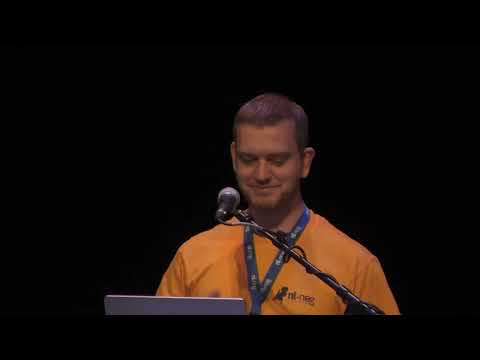
- Why: Not a product pitch — a three-person survey of the "personal ASN" ecosystem (1,354 listed on bgp.tools, 61 in the Netherlands), which is quietly a showcase for the modern lightweight BGP stack: Bird2 + KEES automation, NetBox IPAM, RPKI/ASPA, and VPP on Linux. For the PM's datapath-internals interest, one of the three case studies runs VPP as a production router in a VM.
- What: Three personal networks at increasing ambition: a content network (AS202585) on MikroTik CRS310 hardware at Nikhef/InterDC with Bird2 automated by KEES; an "enterprise" personal network (AS212855) with two Amsterdam routers, Bird 2.17, RPKI/ASPA, IRR dropped in favor of better sources, and a peering portal; and a genuine personal carrier network (AS200132) offering free transit for non-commercial users — Arista 7280SE-64 plus a Dell PowerEdge R640 running Proxmox with VM routers, VPP, Bird, ~160 Gbps capacity, serving a real community (31 of 54 ports occupied, ~4 Gbit traffic, mirrors for CentOS/Fedora/EPEL).
- How: Lots of transferable technique despite the hobby framing: VPP as the datapath on RHEL VMs with resource isolation (PCI passthrough, CPU L2 isolation + taskset); a fork of the KEES automation stack (from Coloclue) handling RPKI/IRR/BGP communities; NetBox for IPAM; Ansible + Semaphore for config; LibreNMS/Smokeping/RIPE Atlas/NLNOG ring for monitoring. War stories: reverse-path filter pain, soft-IRQ tuning killing them, no packaged VPP for RHEL (custom work required).
- Where applicable: Hobby scale, single-digit gigabits — but the patterns (VPP on commodity Linux, KEES-style Bird automation, small-team BGP ops) are exactly what small cloud/DC operators use, and the "addressing crisis" debate about whether hobby ASNs pollute the DFZ is worth knowing. The VPP-on-RHEL lessons apply to anyone considering Linux-vector dataplane routers.
Hardwired for Chaos: The No-Bullsh*t Way to Build Infrastructure That Lasts#
Tony O'Sullivan (RETN, CEO)

- Why: Physical WAN resilience with three recent, well-known stress tests — 2025 Taiwan subsea cable cuts (two suspected sabotage), the Red Sea cable cuts, and the Ukraine war. For a PM whose remit includes DC/WAN interconnect, this is a carrier's argument for geo/vendor/route diversity in the transport layer.
- What: RETN's resilience-first philosophy, backed by case studies: five genuinely diverse, vendor-separated cable paths to Taiwan (stable latency through a 70-day repair window while Tier 1s degraded for weeks/months); the TRANSKZ terrestrial Asia–Europe route absorbing 60–70% of traffic during Red Sea cuts (~70% of EU–Asia subsea capacity lost) at 99.9% uptime; and in Ukraine, a new southern Kyiv route, 72-hour deployable autonomous PoPs with pre-positioned spares, and a capacity-swap deal within a week of the invasion.
- How: Three engineering rules: build for risk (geographic, supplier, and infrastructure diversity with automated reroute, MTTR < 6 h); design smart not big (unique routes like a Milan–Zurich bypass, lean team); optimize efficiency (400GbE rollout, vendor energy benchmarking, watts/Gbps). Plus a call to arms: reclaim the meaning of "resilience," stop buying obviously under-engineered services, demand transparency on infrastructure reality vs. marketing maps, and treat 100% SLA promises as fiction.
- Where applicable: RETN-scale carrier specifics (their own terrestrial routes, cable investments) — but the diversity rules and the industry-myth critique (Tier 1 fallacy, DWDM-ownership-without-control illusion) are broadly applicable to anyone buying transport. Caveat: it's a CEO keynote with promotional intent; the case studies are real but the numbers are RETN's own, not independently evaluated.
Wildcard#
SNTPings: Abusing IPv6 for Art#
Luc Haaijer (Studenten Net Twente)

- Why: Not a talk the PM would ever search for — and exactly why it's worth 15 minutes. Under the "art project" framing is serious fast-path dataplane engineering: line-rate packet processing, userspace networking with DPDK, and an accidental distributed load test that saturated a 40G NIC, a stateful firewall, and a university's upstream.
- What: A 1920×1080 collaborative pixel canvas (in the spirit of r/place and pixelflut) where each "pixel write" is an ICMPv6 echo to a destination address that encodes the pixel — the IPv6 address bits carry X, Y, and BGRA color (
ping6 2001:610:1908:a000:<X>:<Y>:<B><G>:<R><A>). Over 100 participants; the hardware packet counters wrapped multiple times; sustained rate above 72 Mpps, saturating the 40G NIC, a newly installed stateful Fortinet firewall (which, at least, does support IPv6 — through 1920×1080×color distinct destination IPs), and the upstream infrastructure, prompting a "my Wi-Fi is slow" moment campus-wide. - How: DPDK ingests packets in userspace (kernel bypass, NIC hijacked for line-rate receive); destination-address bits are memcpy'd directly into the frame buffer; OpenCV + Gstreamer encode an x264 live stream (codec-compatibility hell noted: Firefox/Linux ∩ Chrome/Windows = ∅); MediaMTX distributes. Network notes: the workload is pps-limited rather than bandwidth-limited; a 40G external tap with 10G internal, and the university upgraded to 2×100G for headroom. Future work: GPU processing via RDMA, FPGA, multiple servers — plus a P4 tap with BGP.
- Where applicable: Campus/event-specific as a project, but the pattern transfers: DPDK userspace receive at tens of Mpps, address-bits-as-payload as a legitimate technique for creative telemetry or encoding, and a vivid reminder that stateful middleboxes are the bottleneck long before the link is.
Themes#
- BMP is having a moment: two independent sessions (bgproutes.io and Rotonda) argue that BMP — with its per-peer, pre/post-policy visibility into
adj_rib_in— is the successor to BGP-session-based route collection, which structurally cannot see filtered or backup routes. Operators should expect BMP-derived datasets and tooling to become the default substrate for routing monitoring and security research. - The optics renaissance reaches operator conferences: 400G coherent over simplex strands (via dual unidirectional optics or circulators), alien waves, DWDM channel planning, and measured loss budgets — a physical-layer skillset reappearing in 2025 programs after years of software-dominated agendas.
- Automation can kill your network "very gracefully": the Delta Fiber postmortem (a permission change yielding an empty dataset that silently deleted all DHCP subnets) is this cycle's canonical lesson — SOT-driven automation needs empty/invalid-input guardrails, and architectural choices (12h renew timers) are what bounded the blast radius.
- Forced lifecycle migrations are producing the best operational content: ISC DHCP's EOL turns every KEA migration talk into a transferable playbook (crawl/walk/run staging, lease migration, monitoring during cutover).
- Resilience rhetoric vs. resilience engineering: the RETN keynote and the Taiwan/Red Sea cable events are pushing the operator community to demand route/vendor/geo diversity evidence rather than SLA numbers — with terrestrial route diversity (TRANSKZ) proving itself under real cable cuts.
- Notable gaps for this PM: zero sessions on identity, passkeys/FIDO, SPIFFE/SPIRE, or agentic identity, and nothing on eBPF/Cilium/service mesh — only the Swisscom talk touches Kubernetes, via GitOps-style artifact enforcement. If those topics matter to the PM's roadmap, this community is not yet discussing them.
About this digest
ToFaRev picked and wrote this digest on Nebius Token Factory, from the conference's published program. A person reviewed it in a pull request before it was published. Write-ups marked "from abstract only" had no fuller source to read. Source: digests/nlnog-2025.md · prompt: prompts/nlnog-2025.md