SIGCOMM 2025#
This is an AI-infrastructure-heavy cycle, and with physical DC/WAN systems treated as core, the program yields a strong Core tier: optics and topology, RDMA/lossless fabrics, hardware transports, programmable-dataplane work, and cloud-native datapath all land squarely in scope. I've pushed pure LLM-serving-algorithm and application-QoE work down or out, and reserved Wildcards for genuinely off-axis novelty.
Academic Ended September 11, 2025 29 picks (16 core · 10 adjacent · 3 wildcard) Program Prompt run by hand
Core#
Mosaic: Breaking the Optics versus Copper Trade-off with a Wide-and-Slow Architecture and MicroLEDs — Kaoutar Benyahya et al. (Microsoft Research / Microsoft Azure) — Core#

Why: Link reach/power/reliability is the binding constraint on future DC fabric scaling; this directly targets the copper-vs-optics wall the PM cares about.
What: A new link technology that abandons the few-high-speed-channels model for hundreds of parallel low-speed channels, claiming copper-beating reach at up to 69% lower power and better reliability than current optics.
How: "Wide-and-slow" spatial multiplexing using directly-modulated microLEDs (not lasers) over massively multi-core imaging fibers, eliminating laser drivers and complex electronics; prototype shows 100 channels × 2Gbps scaling toward 800Gbps+ at up to 50m.
Where applicable: Protocol-agnostic and designed to drop in without server/switch changes — broadly applicable in principle, but still a research prototype, not a shipping transceiver.
InfiniteHBD: Datacenter-Scale High-Bandwidth Domain for LLM with Optical Circuit Switching Transceivers — Chenchen Shou et al. (Peking U. / StepFun / Lightelligence) — Core#
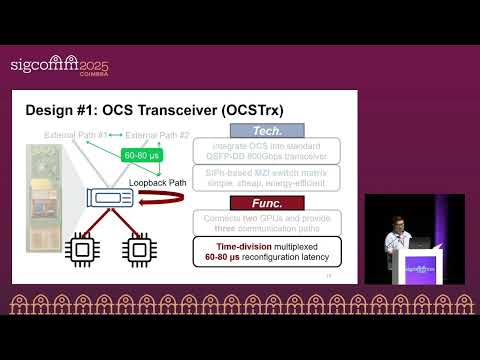
Why: HBD architecture (NVL-72 vs TPU-style) is a live topology/cost/fault-domain debate; this proposes a genuinely different point in that space.
What: A transceiver-centric HBD that embeds optical circuit switching into each transceiver, giving reconfigurable point-to-multipoint links and variable-size ring topologies at ~31% of NVL-72 cost with node-level fault isolation.
How: A silicon-photonic OCS transceiver (OCSTrx), a reconfigurable k-hop ring topology, and an HBD-DCN orchestration algorithm; evaluation claims near-zero GPU waste and 3.37x MFU vs DGX.
Where applicable: Aimed at LLM-training fabrics; depends on custom silicon-photonic transceivers, so it's a direction/architecture signal rather than commodity-deployable today.
Falcon: A Reliable, Low Latency Hardware Transport — Arjun Singhvi, Nandita Dukkipati et al. (Google, with Meta/Nvidia/Microsoft) — Core#

Why: RoCE's PFC/special-fabric dependence limits where hardware transport can go; a multi-vendor general-purpose alternative is strategically significant for DC NIC direction.
What: The first hardware transport supporting multiple Upper Layer Protocols and heterogeneous workloads on lossy, general-purpose Ethernet without special switch support.
How: Delay-based congestion control with multipath load balancing, a layered request-response transaction interface for multi-ULP support, hardware retransmission/error handling, and a programmable engine; first implementation hits 200 Gbps / 120 Mops/sec with op-completion up to 8x lower than CX-7 RoCE under congestion.
Where applicable: Broad ambition (general Ethernet DC), but it's hardware transport — realization depends on NIC silicon adoption; the cross-vendor authorship is itself the signal.
Revisiting RDMA Reliability for Lossy Fabrics (DCP) — Wenxue Li et al. (HKUST, Huawei) — Core#

Why: Getting RDMA off PFC/lossless is one of the cycle's central transport problems and directly relevant to lossless-fabric work.
What: A switch+RNIC co-designed transport that is PFC-independent, RTO-free, packet-spray-compatible, and offload-friendly, claiming 1.6x/2.1x gains over SOTA lossless/lossy RDMA.
How: DCP-Switch adds a simple lossless control plane that DCP-RNIC uses for header-only-based retransmission and bitmap-free packet tracking; prototyped on Tofino2 + FPGA.
Where applicable: General DC RDMA technique, but requires coordinated switch and RNIC changes (prototype silicon), so deployment implies a fabric+NIC co-upgrade.
Alibaba Stellar: A New Generation RDMA Network for Cloud AI — Jie Lu et al. (Alibaba Cloud) — Core#

Why: RDMA virtualization (SR-IOV) pain — slow container spin-up, resource limits, traffic steering — is exactly the multi-tenant cloud-AI networking the PM works on.
What: A production RDMA virtualization stack that spins up virtual devices in seconds, cuts container init time 73%, and improves LLM training speed up to 14%.
How: Para-Virtualized DMA (PVDMA) for on-demand memory pinning, an extended Memory Translation Table (eMTT) for GPUDirect RDMA performance, and RDMA Packet Spray for multipath.
Where applicable: Alibaba-specific production setup; the PVDMA/eMTT ideas generalize but the numbers are from their cluster.
ByteDance Jakiro: Enabling RDMA and TCP over Virtual Private Cloud — Yirui Liu et al. (ByteDance) — Core#

Why: Carrying RDMA and TCP over one VPC overlay with real VPC semantics (security groups, QoS) is a concrete cloud-native multi-tenancy problem.
What: A vNIC design supporting both RDMA and TCP inside a VPC with QoS and security-group enforcement, near-physical RDMA performance, deployed a year in production.
How: A unified vNIC framework that applies VPC features to both stream types while staying compatible with intra-host RDMA optimizations and guaranteeing weighted-fair QoS between RDMA and TCP.
Where applicable: ByteDance-specific production VPC; the dual-stack-over-one-overlay pattern transfers, the deployment specifics don't.
From ATOP to ZCube: Automated Topology Optimization Pipeline and a Cost-Effective Topology for Large Model Training — Zihan Yan, Dan Li et al. (Tsinghua, Zhongguancun Lab, ByteDance) — Core#

Why: DC topology design for training clusters is core physical-networking work, and an automated search plus a concrete new topology is more useful than another hand-tuned fabric.
What: A pipeline that treats topology as hyperparameters to search at tens-of-thousands-of-GPU scale, yielding ZCube, which claims 3–7% faster training and 26–46% lower hardware cost vs ROFT/Rail-only/HPN.
How: Models topology as an optimization problem over training traffic, collective performance, fault tolerance, and cost; evaluated in build/optimize/expand scenarios and validated on a real testbed (25% cost cut vs rail-optimized).
Where applicable: General topology-design methodology for GPU clusters; results are simulation-heavy with a testbed check.
Unlocking Superior Performance in Reconfigurable DCNs with Credit-Based Transport (Flare) — Federico De Marchi et al. (MPI-INF, Meta, NVIDIA) — Core#

Why: Reconfigurable (microsecond-switched) DCNs are a credible post-Moore alternative to Clos, but transport has been the gap; this closes part of it.
What: A credit-based transport that lets RDCNs beat Clos on throughput (up to 1.15x even under adversarial traffic) and substantially cut flow completion times vs NDP/ExpressPass/TDTCP/Bolt.
How: Reliable credit-based delivery that opportunistically routes over the RDCN's rapidly reconfiguring short-path circuits; testbed on programmable switches + DPDK.
Where applicable: Applies to reconfigurable-DCN designs specifically — relevant if/when RDCNs are on the table; mostly simulation plus a feasibility testbed.
Hermes: Enhancing Layer-7 Cloud Load Balancers with Userspace-Directed I/O Event Notification — Tian Pan et al. (Alibaba Cloud) — Core#
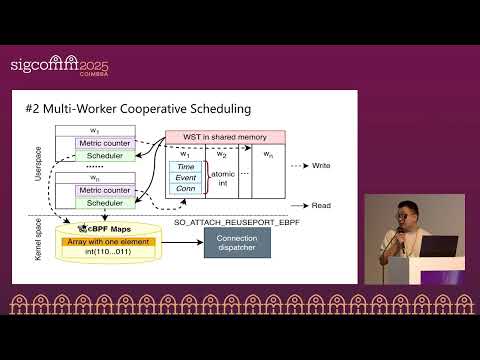
Why: eBPF on the datapath solving a real L7 LB connection-distribution problem (epoll-exclusive LIFO skew, reuseport blindness to worker health) is squarely cloud-native networking.
What: A framework making userspace worker status drive kernel connection dispatch, deployed on O(100K) cores across 33 Alibaba regions, cutting daily worker hangs 99.8% and L7 LB unit cost 18.9%.
How: Lock-free worker-status management plus eBPF overriding reuseport socket selection in a closed loop from userspace to kernel.
Where applicable: General Linux/eBPF technique usable in any Envoy/proxy-style fleet; the scale numbers are Alibaba-specific.
Centralium: A Hybrid Route-Planning Framework for Large-Scale DC Network Migrations — Yikai Lin et al. (Meta, UMass) — Core#

Why: BGP datapath/migration pain is a real operational problem; native BGP can't express the staged, topology-aware conditions migrations need.
What: A Route Planning Abstraction augmenting BGP for centralized planning with distributed enforcement, with 10+ production migration use cases and a substantial reduction in migration time/risk.
How: RPA encodes both sequential and spatial migration conditions BGP can't, driven by a centralized controller deployed alongside existing BGP.
Where applicable: Meta-specific deployment but the abstraction generalizes to any large BGP-routed DC facing migrations.
Fornax: A Hardware-Centric Session Management in Large Public Cloud Network — Heng Yu et al. (Zhongguancun Lab, Tencent, Peking U.) — Core#

Why: SmartNIC-accelerated cloud network functions live or die on their management mechanism; flow-as-unit, one-way command models don't scale to huge tables.
What: A shift from software-centric to hardware-centric management using session (not flow) as the unit, managing up to 16M sessions while cutting software storage 80% and CPU 77%.
How: A session-empowered hardware engine plus two-way hardware-driven management protocols and a lightweight software manager for scalability.
Where applicable: Tencent-specific SmartNIC production setup; the session-as-unit + two-way-protocol idea is a transferable design principle.
Software-based Live Migration for RDMA (MigrRDMA) — Xiaoyu Li et al. (Tsinghua / Microsoft Research) — Core#

Why: RDMA live migration has been "needs NIC support, never ships"; doing it in software on commodity RNICs unblocks host maintenance without hardware changes.
What: A software RDMA live-migration layer with little downtime and only 3–9% datapath overhead, adding ~3s to migrated Hadoop job completion.
How: A software indirection layer that keeps RDMA state identical across source and destination from the application's view, enabling transparent switchover; prototyped on Mellanox RNICs.
Where applicable: General technique on commodity RNICs (validated on Mellanox) — broadly relevant to anyone running RDMA workloads in VMs/containers.
Achieving High-Speed and Robust Encrypted Traffic Anomaly Detection with Programmable Switches (Mazu) — Han Zhang et al. (Tsinghua, Peking U., Sangfor, China Telecom) — Core#

Why: Inline line-rate NIDS for encrypted traffic is a core network-security capability, and this one is production-proven across two ISPs over two years.
What: An inline switch-based IDS detecting malicious traffic at ~90% accuracy within minutes, having caught 10+ critical attack events protecting 10M+ servers.
How: A dual-plane feature-extraction model at near line speed plus a one-class classifier trained only on benign traffic, with an online update mechanism for drift.
Where applicable: ISP/data-center-edge deployment on programmable switches; benign-only training is a sensible general answer to label scarcity.
SpliDT: Partitioned Decision Trees for Scalable Stateful Inference at Line Rate — Murayyiam Parvez et al. (Purdue, Michigan, UCSB, Open U. Israel, NIKSUN) — Core#
Why: In-network ML for security monitoring usually assumes all features upfront; this confronts the data-plane stateful-feature constraint honestly.
What: A framework supporting up to 5x more stateful features and scaling to millions of flows by partitioning decision-tree inference over a sliding packet window.
How: Sequential subtrees each using their own top-k features, with an in-band control channel via packet recirculation managing transitions and reusing match keys/registers; a joint training/DSE workflow optimizes feature allocation, depth, and partitioning.
Where applicable: RMT programmable switches/SmartNICs; a general data-plane-ML technique constrained by switch resources.
RevDNS: Reliable and Decentralized Certificate Revocation via DNS — Protick Bhowmick, Dave Levin, Taejoong Chung (Virginia Tech, U. Maryland) — Core#

Why: Web-PKI revocation is broken and OCSP-over-CDN recentralizes trust (Akamai serves ~62% of revocation responses) — directly relevant to the PM's PKI/identity interest.
What: A DNS-based revocation scheme where resolvers answer ~99.8% of checks locally without contacting a CA, with no added latency and no extra user disclosure.
How: Revoked serials live in DNSSEC-signed TXT records; NSEC proofs enable aggressive negative caching; a large CA like Let's Encrypt can publish 612M certificates in a 345MB zone.
Where applicable: General web-PKI proposal; a concrete alternative to OCSP and short-lived certs that keeps revocation authority with CAs.
Designing Transport-Level Encryption for Datacenter Networks (SDP) — Tianyi Gao et al. (University of Edinburgh) — Core#
Why: Encryption for next-gen DC transports (NDP, Homa) is where DC transport security is heading; touches both fabric and security.
What: A protocol design integrating data encryption into emerging datacenter transports with TLS-style NIC offload.
How: Supports NIC offloading modeled on TLS-over-TCP, a native protocol number alongside TCP/UDP, and a message-based abstraction for low-latency parallel RPCs. (Short paper — abstract is thin; treat as a direction-setter, not a finished design.)
Where applicable: General DC-transport proposal; early-stage.
Adjacent#
ZENITH: Towards a Formally Verified Highly-Available Control Plane — Pooria Namyar et al. (USC, Google) — Adjacent#

Why: The "correct-by-construction vs. periodic reconcile" argument maps directly onto Kubernetes-style controller design the PM will recognize.
What: A microservice SDN controller that avoids state inconsistency by design, machine-verified, resolving inconsistencies 5x faster than reconciliation-based designs.
How: A formally verified specification with code auto-generated from it, plus abstractions letting developers independently verify SDN apps.
Where applicable: SDN control planes; the design philosophy generalizes to any reconciler-based system.
S2: A Distributed Configuration Verifier for Hyper-Scale Networks — Dan Wang et al. (Xi'an Jiaotong, Northwest U., ByteDance) — Adjacent#

Why: Config verification is operationally adjacent; single-box verifiers stall past ~10K switches / 1000M routes that large providers actually run.
What: A scale-out verifier reaching 10K routers and 1000M routes within 2 hours by distributing across servers.
How: Partitions the network model and distributes control-plane simulation + data-plane verification across machines, with prefix sharding to cut per-server memory; built on Batfish.
Where applicable: Large service-provider/DC networks that outgrew single-server Batfish; general approach.
New Evolution of Hoyan: Alibaba's Global WAN Verification — Yifei Yuan et al. (Alibaba Cloud) — Adjacent#

Why: A multi-year production verification story with hard before/after numbers (misconfig incidents 56% → 5%) is the kind of operational evidence worth seeing.
What: A distributed evolution of Hoyan scaling to O(10^4) routers, millions of prefixes, billions of flows, plus a route-change-intent specification language (RCL).
How: Centralized-to-distributed simulation (5x faster), RCL for expressing/verifying route-change intents, and an enhanced accuracy-diagnosis framework.
Where applicable: Alibaba-specific WAN, but the RCL idea and the distributed-simulation approach transfer.
PreTE: Traffic Engineering with Predictive Failures — Congcong Miao et al. (Tencent, MIT, UCSB, Meta, Tsinghua) — Adjacent#

Why: Fiber cuts are rare-but-disruptive WAN events; folding measured optical-layer degradation into TE is a fresh, physically grounded angle on availability.
What: A TE system that factors dynamic fiber-cut probabilities into tunnel planning, supporting up to 2x more demand at equal availability.
How: Per-second optical-layer measurements show failure probability jumps orders of magnitude in an ephemeral degradation state; PreTE predicts from that and proactively updates tunnels then re-optimizes allocation.
Where applicable: WAN operators with optical-layer telemetry; assumes access to per-second optical data.
Confucius: Intent-Driven Network Management with Multi-Agent LLMs — Zhaodong Wang et al. (Meta, JHU, Harvard, Stony Brook) — Adjacent#

Why: First credible hyperscale report on multi-agent LLMs for network ops — useful signal on agentic operations adjacent to the PM's agentic-identity interest.
What: A production multi-agent framework, operational two years with 60+ apps, modeling management workflows as DAGs.
How: LLMs integrated with existing tools, RAG for long-term memory, human/model interaction primitives, and tight coupling to existing validation to prevent regressions.
Where applicable: Meta-scale ops; the architecture is a reference point for agentic network management generally.
Understanding and Profiling CXL.mem Using PathFinder — Xiao Li et al. (UW-Madison/Beihang, Intel) — Adjacent#

Why: CXL memory pooling is becoming widely deployed and can stall co-located apps; the community lacks end-to-end profiling, which matters for DC resource disaggregation.
What: A utility that captures CXL.mem execution end-to-end between CPU and remote DIMM for profiling, bottleneck analysis, and anomaly diagnosis.
How: Models the CXL.mem data path as an execution graph from architectural performance counters and applies graph analysis to associate CXL with competing memory flows.
Where applicable: Servers with CXL.mem; a general diagnostic tool, increasingly relevant as memory disaggregation lands.
Censys: A Map of Internet Hosts and Services — Zakir Durumeric et al. (Censys Inc.) — Adjacent#

Why: Attack-surface and security-measurement context the PM tracks adjacent to network security.
What: A retrospective on Censys's re-architecture for continuous Internet-wide scan data, with a visibility evaluation and lessons learned.
How: Operational account of redesigning collection/packaging and serving research/industry/government users; discusses unsolved problems.
Where applicable: Internet-measurement infrastructure; general reference.
Formalizing Dependence of Web Infrastructure — Rumaisa Habib, Kimberly Ruth, Gautam Akiwate, Zakir Durumeric (Stanford) — Adjacent#

Why: Relevant to identity/PKI via the CA-dependence lens and to resilience reasoning generally.
What: A rigorous statistical metric for Internet centralization that disentangles centralization from regionalization across hosting, DNS, and CAs in 150 countries.
How: A suite of statistical tools applied across three web-infrastructure layers.
Where applicable: General measurement/policy toolkit. (Note: the program text for "Hummingbird: Fast, Flexible, and Fair Inter-Domain Bandwidth Reservations" is an identical copy of this centralization abstract — Hummingbird's title is about bandwidth reservations, so its abstract appears mis-pasted in the program; flagging rather than guessing its content.)
Threading the Ocean: Mapping Digital Routes Across Submarine Cables using Calypso — Caleb Wang et al. (Northwestern, U. Oregon) — Adjacent#
Why: Submarine cables are the physical WAN backbone with real security/economic exposure; mapping traffic to cables is genuine DC/WAN-interconnect infrastructure work.
What: A framework mapping traceroutes to the submarine cables they traverse, plus "Route Stress," a metric estimating cable criticality.
How: Infers traceroute-to-cable mappings despite industry opacity and validates with case studies on SCN vulnerability.
Where applicable: Global connectivity/resilience analysis; research framework.
Inter-domain Routing with Extensible Criteria (IREC) — Seyedali Tabaeiaghdaei et al. (Anapaya, ETH Zurich, others) — Adjacent#

Why: BGP/datapath internals and path-aware networking are in scope; extensible inter-domain criteria is a forward-looking control-plane idea.
What: An inter-domain routing architecture for SCION enabling path optimization on extensible, end-domain-specified criteria.
How: Parallel execution and real-time addition of independent route computations over SCION's stateless forwarding, with negligible global cost vs static routing in large-scale simulation.
Where applicable: SCION/path-aware networks specifically; not deployable on vanilla BGP.
Wildcard#
Orderlock: A New Type of Deadlock and its Implications on HPN Protocol Design — Weihao Jiang et al. (SJTU, Nanjing U.) — Wildcard#

Why: A genuine impossibility result is the kind of conceptual lever that outlasts any benchmark and reshapes how to reason about transport feature combinations.
What: Proves that in-order delivery + lossless transmission + out-of-order capability are jointly impossible without risking a new deadlock class ("Orderlock"), and explores Orderlock-free designs.
How: Formal necessary-and-sufficient-condition proof, plus a case study tuning AI-workload performance under Orderlock-free protocols.
Where applicable: General theory for HPN protocol/hardware co-design — a reasoning tool, not a system.
Direct-to-Cell Satellite Network without Satellite Navigation (SN²) — Wei Liu et al. (Tsinghua) — Wildcard#

Why: The failure mode is fundamentally an authn/authz-and-location problem in disguise — GNSS as an implicit trust dependency for access control is a framing the identity-minded PM will appreciate.
What: Shows direct-to-cell satellite networks' over-reliance on GNSS for geolocation/timing causes mis-billing, unauthorized service, and denials, and proposes self-navigation from the satellites themselves.
How: A "fate-sharing" approach reusing the direct-to-cell satellites for built-in navigation, trading navigation accuracy for availability; validated with commodity satellite phones on 3GPP NTN stacks.
Where applicable: Direct-to-cell / NTN satellite systems; the trust-dependency lesson generalizes beyond space.
Firefly: Scalable, Ultra-Accurate Clock Synchronization for Datacenters — Pooria Namyar et al. (Google, USC, NVIDIA) — Wildcard#

Why: Precise time quietly underpins distributed consistency, certificate/token validity windows, and ordering — sub-10ns in software is a striking result with security and distributed-systems reach.
What: A software-driven clock-sync system hitting sub-10ns device-to-device and ≤1µs device-to-UTC in a 248-machine Clos, resilient to time-server failure and unstable clocks.
How: Distributed consensus on a random overlay graph with gradual hardware-clock adjustment, plus "layered synchronization" decoupling internal (device-to-device) from external (to-UTC) sync.
Where applicable: Datacenter timing (e.g., cloud financial exchanges); software-only, broadly applicable where hardware PTP is impractical.
Themes#
- AI training/inference infrastructure dominates the program. Collective-communication scheduling (SyCCL, ResCCL, Hermod), MoE serving/fabric (MegaScale-Infer, MixNet), HBD/optical fabrics (InfiniteHBD, Mosaic), topology search (ZCube), and RDMA-for-AI (Stellar) — the center of gravity in systems networking has shifted to the AI datapath.
- Optics and reconfigurable fabric are back as first-class topics. Mosaic (microLED wide-and-slow links), InfiniteHBD (OCS-in-transceiver), MixNet (optical-electrical reconfiguration), and Flare (transport for reconfigurable DCNs) all attack the physical-layer scaling wall rather than just the protocol stack.
- RDMA without lossless/PFC is a live front. DCP, Falcon, and Jakiro independently push toward reliable RDMA over lossy, general-purpose, multi-tenant Ethernet — the PFC-dependence escape is this cycle's recurring transport problem.
- In-network ML, with a built-in reality check. Decision trees and DL on programmable switches/SmartNICs are widespread (SpliDT, Pegasus, Mazu, NPC), but "The Sweet Danger of Sugar" lands a methodological broadside on how encrypted-traffic ML is evaluated — enthusiasm and skepticism in the same program.
- Verification and correctness-by-construction matured to production. ZENITH (verified, code-generated control plane), S2 (scale-out config verification), and Hoyan (multi-year WAN verification with 56%→5% incident reduction) show formal methods moving from single-box tools to deployed systems.
- LLMs/agents are entering network operations. Confucius, BIAN, and SkyNet mark a turn toward LLM-assisted diagnosis, failure localization, and intent-driven management at hyperscale — early but production-grounded.
A caveat on what's not here: there's little direct passkeys/FIDO/OAuth/OIDC or SPIFFE/SPIRE workload-identity work — SIGCOMM remains a systems/datapath venue, so the identity-relevant picks (RevDNS, SN², the centralization papers) approach it from the PKI/trust-dependency angle rather than authn protocols.
About this digest
This digest was produced by running the repository's digest prompt by hand, from the conference's published program. Source: digests/sigcomm-2025.md · prompt: prompts/sigcomm-2025.md