GTC 2026#
Notes on this digest: of the 24 pre-selected items, 21 made the cut. "Accelerated AI Networking with DOCA" was dropped as a platform-overview pitch redundant with the security-focused DOCA session. "Accelerated Networking for AI Infrastructure" and "Deep Dive on Gigawatt AI Factories" were removed because NVIDIA provides neither slides nor a recording, and the Cisco session was demoted from Core to Adjacent as a sponsor-flavored talk with no specifics in its abstract. Enrichment was attempted but the session-catalog pages are JavaScript-rendered and returned only site chrome, so every write-up below is from the abstract only — treat specifics (numbers, mechanisms) as claims to verify in the recording.
March 16, 2026 – March 19, 2026 Program
Core#
Scaling Out and Across: Networking Innovations for Giga-Scale AI Systems#
Gilad Shainer (NVIDIA) — Talk, Monday, March 16
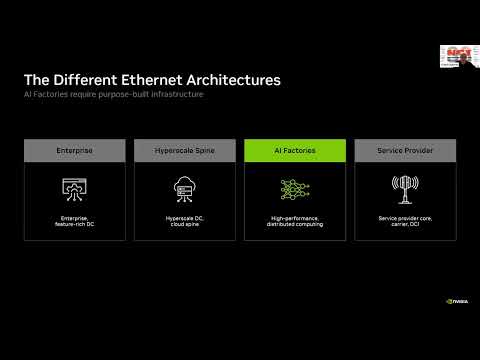
- Why: The roadmap talk for where datacenter fabrics are heading as clusters go from hundreds of thousands toward millions of GPUs — ultra-high-radix switching, co-packaged optics, and multi-site scale-across are all in the PM's lane.
- What: An unveiling of NVIDIA's networking portfolio for giga-scale AI: next-generation Quantum-X InfiniBand and Spectrum-X Ethernet platforms with co-packaged optics, ultra-high-radix switches, and accelerator-optimized SuperNICs, aimed at training foundation models, real-time inference, and federated AI factories across sites. (from abstract only)
- How: Abstract-level mechanisms only: co-packaged optics on switch platforms, SuperNIC-optimized host interfaces, and fabric designs targeting predictable latency and lossless throughput across sites.
- Where applicable: NVIDIA product roadmap — expect heavy positioning, but it is the clearest signal of the next fabric generation (radix, optics integration, scale-across) and worth attending for that alone.
Build a High-Performance Research Cluster#
Chris Turpin, Jerome Vienne (Qube Research & Technologies) — Talk, Monday, March 16
- Why: A genuine end-user design-and-operate talk with deployment lessons, observability patterns, and troubleshooting detail — exactly the failure-inclusive case-study content worth up-ranking.
- What: An end-to-end design walkthrough of a high-performance research cluster using B200 HGX and Spectrum-X, covering NVLink/NVSwitch topologies, intra- and inter-host multi-GPU communication, and validation with real workloads, plus "hard-won lessons": observability patterns, common misconfigurations, and troubleshooting techniques. (from abstract only)
- How: Design decisions validated against real workloads rather than synthetic microbenchmarks; the troubleshooting content implies real incidents, though the abstract doesn't quantify them.
- Where applicable: QRT-specific (quant research) cluster on the NVIDIA HGX + Spectrum-X stack; the design and ops lessons transfer well to similar on-prem HGX-class builds.
Enable Enterprise AI Factories With Secure, High-Performance Networking#
Yael Shenhav (NVIDIA), Chris Wright (Red Hat) — Talk, Monday, March 16
- Why: DPU-based isolation — separating infrastructure services from user workloads to shrink attack surface — is squarely the PM's network-security interest, and Red Hat's CTO co-presenting signals real enterprise pull.
- What: How Red Hat OpenShift, NVIDIA BlueField DPUs, and high-performance Ethernet fabrics combine into enterprise AI infrastructure, with DPU-based isolation enforcing policy boundaries between infrastructure and tenant workloads. (from abstract only)
- How: BlueField offloads infrastructure services and policy enforcement away from host compute; OpenShift automates provisioning, updates, monitoring, and troubleshooting of BlueField-enabled nodes to make the pattern operable at enterprise scale.
- Where applicable: Requires the OpenShift + BlueField + NVIDIA Ethernet stack; enterprise (not hyperscale) focus. Product-pitch elements are real, but the DPU-isolation pattern is broadly relevant to multi-tenant AI platforms.
Safety in the OpenClaw Era#
Elia Zaitsev (CrowdStrike), Ali Golshan (NVIDIA), Amit Zavery (ServiceNow), Francis deSouza (Google Cloud) — Panel, Monday, March 16
- Why: Autonomous agents that hold credentials, persist context, spawn subagents, and run continuously against production systems are a different threat model — and agentic identity is one of the PM's core interests. This panel names the gap explicitly.
- What: A panel asking what a real security model for autonomous agents looks like, on the premise that agents are ready but the governance and trust infrastructure to run them at scale does not yet exist. (from abstract only)
- How: The abstract frames the attack surface concretely: every prompt injection is a potential credential leak, every third-party skill is an unreviewed binary, and every major enterprise platform is becoming an agent platform without matching governance.
- Where applicable: Conceptual, vendor-neutral in applicability — any organization deploying agentic workloads. No metrics expected from a panel; value is in where the speakers say the model needs to change.
Redefining Scalable AI Performance: OCI Supercomputing in the Cloud (Presented by Oracle)#
Jagwinder Brar, Taylor Newill (Oracle) — Talk, Tuesday, March 17
- Why: A third-party cloud fabric datapoint at extreme scale — OCI's Acceleron RoCE network connecting hundreds of thousands of GPUs is one of the few large-scale non-InfiniBand production fabrics with public numbers.
- What: How OCI connects hundreds of thousands of NVIDIA GPUs into AI superclusters claimed at up to 16 zettaFLOPS peak, with Acceleron ultra-low-latency RoCE networking and next-generation GPU instances improving LLM throughput, multimodal/scientific workload speed, and cluster utilization. (from abstract only)
- How: Abstract does not explain how Acceleron achieves its latency characteristics — that detail is the thing to extract in the room or from the recording.
- Where applicable: OCI-specific deployment; "Presented by Oracle" means expect positioning, so treat the perf claims as marketing until verified. Still, as a hyperscale RoCE reference point it is worth the skepticism-and-all read.
Build Secure AI Infrastructure With DOCA#
Ofir Arkin, Ariel Kit (NVIDIA) — Talk, Tuesday, March 17
- Why: Line-rate network security enforced from the DPU without host agents or touching protected workloads is the strongest network-security offering in this program — and it extends toward prompt-level defenses and agentic-workflow security, both new territory.
- What: The DOCA security stack (microservices, frameworks, APIs) running on BlueField: granular network security policy at line rate, real-time detection and blocking of threats to AI workloads, prompt-level defenses, and security for agentic workflows — framed as protecting AI without consuming compute or hurting token economics. (from abstract only)
- How: BlueField enforces policy in the datapath at line rate, independent of host software; the prompt-level and agentic components are the newest claims and the least mechanistically described in the abstract.
- Where applicable: Requires NVIDIA BlueField DPUs; NVIDIA-centric stack. The line-rate policy piece is proven ground; treat the prompt-level and agentic-security claims as early and demand the mechanism.
A New Paradigm: Verifiable AI#
Ofir Arkin (NVIDIA), Jonathan Dotan (EQTY Lab), Caroline Yap (Sovereign AI) — Talk, Wednesday, March 18
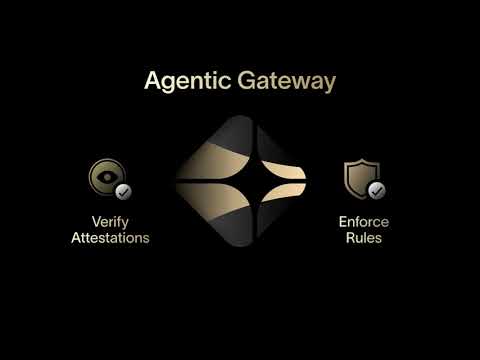
- Why: Continuous verification of autonomous systems' operations, security, and alignment — an attestation-shaped idea applied to agents and physical AI — is directly relevant to where the PM's workload/agentic identity work is heading.
- What: EQTY's verifiable AI runtime: an approach that continuously ensures verified integrity from model training and inference through to deployment in physical AI environments, including verification of AI sovereignty. (from abstract only)
- How: The abstract does not specify the verification mechanism; it is positioned as a runtime spanning cloud to edge for multi-agent systems.
- Where applicable: Early-stage and vendor-led (EQTY product introduction); directional rather than deployable today, but it previews the trust/attestation layer agentic platforms will need.
How AI Factories Can Shift-left to Accelerate Infrastructure and Ecosystems Readiness#
Amit Katz (NVIDIA), Harshdeep Banwait (CoreWeave) — Talk, Wednesday, March 18
- Why: Validating the full stack in a network digital twin before hardware arrives directly attacks the build-then-test bottleneck — and bring-up/day-1 readiness is a real pain point in large DC deployments.
- What: A shift-left methodology powered by digital twins across the AI factory lifecycle: CoreWeave's experience using NVIDIA Air to decouple software automation from hardware lead times, and NVIDIA's use of twin environments to let ISVs develop against next-gen platforms without physical hardware. (from abstract only)
- How: Simulation-first: the network and host stack are modeled in NVIDIA Air so automation, cloud software, and partner integrations are validated before the physical infrastructure exists.
- Where applicable: NVIDIA Air tooling with a CoreWeave end-user component; the methodology (pre-hardware network/system validation) generalizes to any large build-out where hardware lead times gate software readiness.
Supercharging AI With Multi-Gigawatt AI Factories#
Gilad Shainer, Peter Salanki (CoreWeave), Omar Baldonado (Meta), Yuya Kawakami (SoftBank), Alexis Bjorlin (NVIDIA), Evan Burness (Microsoft) — Panel, Wednesday, March 18
- Why: The strongest lineup in the program for operator war stories — Meta, Microsoft, CoreWeave, and SoftBank builders in one room on network scaling lessons at hyperscale.
- What: A panel on hard-won lessons from building massive AI infrastructure, strategies for scaling network performance across clusters, and predictions for next-generation AI networking. (from abstract only)
- How: Panel format — no mechanism to summarize; the abstract promises "practical guidance" but has no specifics, so the value depends entirely on the panelists' candor.
- Where applicable: Hyperscale and neocloud deployments spanning multiple operators; expect mixed InfiniBand/Ethernet perspectives. High signal-if-candid, zero signal if it turns into a roadmap chorus.
Building Sovereign AI: Scaling 100B+ Model Training on NVIDIA Blackwell Infrastructure (Presented by Lablup, Inc.)#
Jeongkyu Shin (Lablup, Inc.) — Theater Talk, Wednesday, March 18

- Why: The most concretely operational talk in the pre-selection: named failure modes (NCCL timeouts, 10x storage degradation from an NFS driver bug, MXFP8 precision instability on Blackwell) and network tuning (RoCE and InfiniBand) on a 500+ B200 national-scale cluster.
- What: Hands-on experience training 100B+ parameter models from scratch on more than 500 B200 GPUs in a sovereign AI initiative: fault-tolerant orchestration, storage I/O optimization, NCCL tuning, automated failure recovery, resolution of a 10x storage slowdown traced to NFS driver issues, MXFP8 stability work, and RoCE/InfiniBand network tuning done through cross-vendor collaboration. (from abstract only)
- How: A resilient stack with automated failure recovery, exploiting LLM training's parallelism characteristics for large-capacity fault tolerance and data-driven fault demarcation and localization.
- Where applicable: Lablup's deployment in a Korean national sovereign-AI initiative; NVIDIA Blackwell with both RoCE and InfiniBand fabrics present. The failure-and-fix detail is what makes it valuable; scale (hundreds, not tens of thousands, of GPUs) makes it relatable to enterprise builds.
Enhance Data Center Efficiency and Throughput by Co-Scheduling on NVIDIA CPU+GPU Systems#
Brian Austin (NERSC), Mathias Wagner (NVIDIA) — Talk, Thursday, March 19
- Why: Utilization economics for coherent CPU-GPU systems, with concrete isolation mechanisms the PM can use directly — cgroups, ARM MPAM cache/memory-bandwidth partitioning, and InfiniBand QoS for network traffic separation.
- What: Co-scheduling CPU-only, partially accelerated, and fully GPU-accelerated jobs on the same coherent CPU-GPU nodes to boost throughput and energy efficiency, removing the need for dedicated per-workload clusters, with workload studies for NERSC's upcoming Doudna system and projected utilization/efficiency gains. (from abstract only)
- How: Isolation via CPU affinity (cgroups), cache and memory-bandwidth partitioning through ARM's MPAM extensions, and InfiniBand QoS for network separation; plus methodology for identifying co-scheduling candidates and designing scheduling policies users will accept.
- Where applicable: NERSC HPC context (Doudna, Grace-based coherent nodes), but cgroups/MPAM/IB-QoS are general techniques for any shared GPU fabric; the policy/ incentive discussion is broadly applicable to mixed-workload clusters.
Break Communication Barriers: Scale AI and HPC with NCCL, NIXL, and NVSHMEM#
Matthew Nicely (NVIDIA) — Talk, Thursday, March 19
- Why: The internals of the GPU communication stack — symmetric memory, copy-engine collectives, zero-SM communication, and NIXL's tier-spanning async transfers — are datapath and RDMA-adjacent content central to the PM's interests.
- What: A year of evolution across the three libraries: NCCL added Symmetric Memory and Copy Engine collectives enabling zero-SM communication; NVSHMEM enhanced GPU-initiated operations in the Python ecosystem; NIXL emerged for inference, providing async noncontiguous transfers across memory tiers (HBM, DRAM, local/networked storage) with GDS, UCX, and S3 backends. Plus developer-level material: custom NCCL collectives, KV-cache and storage innovations in NIXL, expert-parallelism patterns, and Spectrum-X plugins for multi-site scale-across. (from abstract only)
- How: Library-level mechanisms per above; the zero-SM collectives and NIXL's cross-tier transfers are the pieces that matter for disaggregated inference architectures.
- Where applicable: NVIDIA GPU clusters — vendor stack, but the de facto standard for GPU collective communication; the NIXL/disaggregated-inference material applies wherever KV cache and weights move between memory tiers over a fabric.
Build a Software-Defined Multi-Tenant NVLinked Cluster#
Adam Tetelman (NVIDIA), Alex Saroyan (Netris), Lukas Gentele (vCluster Labs) — Talk, Thursday, March 19
- Why: The one session in this set that stitches cloud-native tooling (Netris network automation, vCluster tenancy) onto an NVL GPU cluster — directly relevant to the PM's Kubernetes-networking and fabric-automation interests.
- What: A reference architecture for a single enterprise-grade, software-defined, multi-tenant NVL GPU cluster, examined across infrastructure, platform, and software layers, with a concrete example integrating Run:ai, Base Command Manager, vCluster, and Netris to handle production requirements: stricter security, operational rigor, and a broad user base. (from abstract only)
- How: Layered design: network automation (Netris), virtualization, orchestration platforms, plus the named-tool reference integration; abstract doesn't detail the per-layer mechanisms.
- Where applicable: Tied to specific vendor products (Run:ai, BCM, vCluster, Netris) on NVIDIA NVL hardware; the multi-tenant-GPU-cluster pattern itself is broadly applicable to R&D clusters going to production.
Adjacent#
Transforming Bottlenecks into Breakthroughs: Scaling Secure AI Networks for AI Factories (Presented by Cisco Systems)#
Will Eatherton (Cisco) — Talk, Wednesday, March 18
- Why: The main non-NVIDIA silicon and optics perspective on AI fabrics at NVIDIA's own show — worth tracking for competitive triangulation even though the abstract reads as pure positioning.
- What: Cisco + NVIDIA joint work on AI networking across silicon, systems, software, and optics, with scale-fabric architectures and validated designs aimed at bandwidth, latency, and security limits of AI workloads. (from abstract only)
- How: No mechanism specifics in the abstract — expect validated-reference-design content rather than internals.
- Where applicable: Cisco + NVIDIA joint stack; sponsor-flavored and number-free, so treat as directional. Kept in the digest because a second vendor's view of AI-fabric scaling (especially optics) is otherwise absent from this program.
From Kernels to Clusters: How PyTorch Powers High-Performance AI (Presented by Meta)#
Alban Desmaison (Meta) — Theater Talk, Monday, March 16
- Why: Torchcomms — a vendor-neutral, scalable communication layer — is the open-ecosystem counterpart to NCCL/NIXL, and the PM's dataplane interest makes that layer's direction worth knowing.
- What: PyTorch's high-performance stack: custom kernel authoring, the Helion compiler stack, Monarch's next-generation distributed runtime for reinforcement learning, Torchcomms' vendor-neutral communication layer, and fault tolerance/elasticity for reliable training at massive scale. (from abstract only)
- How: Abstract describes scope but not mechanisms; the comm-layer and elasticity internals are what to look for in the full talk.
- Where applicable: Open-source PyTorch ecosystem, Meta-scale training context; relevant to anyone evaluating whether the open stack can route around vendor-locked communication libraries.
Continuous Inference Benchmarking of the AI Frontier#
Cameron Quilici, Dylan Patel, Kimbo Chen (SemiAnalysis) — Talk, Tuesday, March 17
- Why: Independent, nightly, reproducible inference benchmarks with energy and cost-per-token dimensions — useful third-party context for any infra capacity or accelerator evaluation the PM does.
- What: InferenceX, SemiAnalysis' open-source benchmark suite: nightly sweeps of the latest software optimizations across leading AI accelerators, moving beyond peak metrics to throughput, energy consumption, cost-per-token, and user-facing interactivity thresholds. (from abstract only)
- How: Multidimensional, continuously-run benchmarking rather than static datasheet comparison; the talk covers design, execution, and interpretation of results.
- Where applicable: Cross-vendor accelerators; third-party (not vendor) analysis. Directly usable for procurement and capacity planning; methodology transfers to internal benchmarking programs.
Co-Engineering Grace CPU Platforms for Hyperscale#
Shobhit Kanaujia, Abhishek Dhanotia (Meta), Ian Finder (NVIDIA) — Talk, Tuesday, March 17
- Why: End-to-end platform co-engineering at one of the world's largest fleets — performance-per-watt and rack-density context that shapes DC planning even though it isn't a networking talk per se.
- What: How Meta and NVIDIA co-engineer Grace CPU-based platforms for Meta's diverse fleet (training, inference, web services, ranking, caching, analytics, video processing), improving performance per watt, rack density, and fleet efficiency. (from abstract only)
- How: Joint work across silicon, platform design, and infrastructure integration; abstract doesn't detail the mechanisms or quantify the gains.
- Where applicable: Meta-specific fleet at hyperscale; the co-engineering process observations generalize, the results are fleet-specific.
Robust LLM Training Infrastructure at ByteDance#
Zuquan Song (ByteDance Seed) — Talk, Wednesday, March 18
- Why: A real production number — 97% effective training time over a three-month, 9,600-GPU run — attached to a described fault-tolerance system; strong adjacent content on training-robustness engineering.
- What: ByteRobust, a GPU infrastructure management system for robust LLM training that handles NaN values, CUDA errors, and job hangs, achieving large-capacity fault tolerance, prompt fault demarcation, and data-driven localization; deployed in production with 97% effective training time ratio on a three-month training job across 9,600 GPUs. (from abstract only)
- How: Leverages LLM training's parallelism and workload characteristics for fault tolerance and fault localization via a data-driven approach.
- Where applicable: ByteDance's production platform; the metrics are real but transferability depends on how much of the demarcation/localization method is shared in the talk.
Solve the Day 1 Challenge of Landing LLM Inference in Enterprise#
Tongyu Guo, Kai Zhang (Alibaba Cloud Intelligence) — Talk, Thursday, March 19
- Why: Kubernetes-native lifecycle management for prefill-decode disaggregated inference — the cloud-native-orchestration side of a problem the NCCL/NIXL talk covers from the datapath side.
- What: ACK RBG, Alibaba Cloud's tool for full-lifecycle LLM inference deployment on Kubernetes: multi-role management, automatic service discovery, topology-aware placement, elastic scaling, and atomic rollout/failure recovery for PD-disaggregation architectures, tightly integrated with NVIDIA Dynamo's AIConfigurator and Planner for performance profiling and smarter scaling in PD and MoE scenarios. (from abstract only)
- How: Kubernetes controllers/operators implementing the lifecycle features, plus Dynamo integration for profile-driven scaling decisions; abstract doesn't detail placement or recovery internals.
- Where applicable: Alibaba Cloud ACK, Kubernetes-based; specific to PD-disaggregation and MoE inference at scale. One of the few documented large-scale production deployments of NVIDIA Dynamo.
Wildcard#
Achieve Truly Serverless GPUs With libfuse, CRIU, and CUDA-Checkpoint#
Charles Frye (Modal) — Talk, Tuesday, March 17
- Why: Serverless inference only works if GPU containers boot fast — and the checkpoint/restore mash (CRIU + CUDA-Checkpoint + libfuse) used to get there is genuinely novel systems work the PM wouldn't naturally search for.
- What: The techniques Modal developed to speed up GPU container boots and achieve truly serverless execution for workloads across thousands of GPUs. (from abstract only)
- How: Process checkpoint/restore via CRIU combined with CUDA-Checkpoint for GPU state and libfuse for filesystem setup — the abstract names the tools but not the measured boot-time gains.
- Where applicable: Modal's platform at thousands-of-GPUs scale; the techniques generalize to any system that needs fast cold-start of GPU replicas.
Quantum and HPC at Riken: The Sum is Greater than Its Parts#
Satoshi Matsuoka, Mitsuhisa Sato (Riken) — Talk, Tuesday, March 17
- Why: Off-topic for AI fabrics, but the systems problem — orchestrating wildly heterogeneous compute (Fugaku supercomputer, GB200 clusters, superconducting and ion-trap QPUs) over low-latency RPC — rhymes with disaggregated-inference orchestration, and hybrid quantum-HPC utility results are a field-direction signal.
- What: The JHPC-Quantum project: integrating the Fugaku supercomputer and NVIDIA GB200 clusters with superconducting and ion-trap QPUs, with a tightly coupled software stack and hybrid quantum-HPC algorithms achieving utility-scale results on realistic problems in quantum chemistry and CFD — not just quantum-favorable ones. (from abstract only)
- How: Low-latency RPC middleware orchestrates the heterogeneous resources; the hybrid algorithms are co-designed with the coupling.
- Where applicable: Riken-specific research infrastructure; early-stage, but the latency-and-orchestration design space overlaps with multi-tier AI systems, and Matsuoka's systems talks are reliably substantive.
Themes#
- Scale-across is the new frontier: multiple sessions (Shainer's roadmap, the multi-gigawatt panel, NVL72 deep dives, Spectrum-X plugins in the NCCL talk) treat multi-site, latency-predictable, lossless interconnect of federated AI factories as the defining network problem after scale-up/scale-out.
- Optics are moving into the package: co-packaged optics on both Quantum-X InfiniBand and Spectrum-X Ethernet signals the shift away from pluggable-dominated DC optics at AI scale — a structural change for anyone buying DC optics and cabling.
- Security is moving into the DPU and the fabric: DOCA security microservices, BlueField line-rate policy, and DPU-based tenant isolation recast network security as offload rather than host agents — with an explicit pitch that security must not tax AI "tokenomics."
- The agentic trust gap is now named openly: the OpenClaw panel, DOCA's agentic-workflow security, and the verifiable-AI runtime all concede that governance and identity infrastructure for autonomous agents doesn't exist at scale — a clear engagement window for identity-focused work (credential scoping, attestation, agent-to-agent trust).
- Failure engineering is a first-class infrastructure discipline: Lablup's NCCL/storage/precision failures, ByteDance's 97% effective-training-time run, PyTorch elasticity, and shift-left digital twins collectively show the field treating fault tolerance, fault localization, and pre-hardware validation as core design inputs, not afterthoughts.
- Disaggregated inference is driving a second communication-stack evolution: NIXL's async transfers across HBM/DRAM/storage tiers, KV-cache movement, Alibaba's PD-disagg Kubernetes orchestration, and Torchcomms' vendor-neutral layer all point to inference datapaths — not training collectives — as where comm-stack innovation is concentrating.
About this digest
ToFaRev picked and wrote this digest on Nebius Token Factory, from the conference's published program. A person reviewed it in a pull request before it was published. Write-ups marked "from abstract only" had no fuller source to read. Source: digests/gtc-2026.md · prompt: prompts/gtc-2026.md