OVS + OVN 2025 Fall Conference (Prague)#
This year's program is unusually dense in the PM's core territory: OVN is growing native fabric integration (BGP, BGP-EVPN, transit router), DPUs and hardware offload are driving new upstream OVN/OVS features, and AI/GPU workloads are stress-testing overlay designs. Watch for vendor framing on the NVIDIA DPU talks — several include real testbed numbers, which lifts them above pure product pitch.
November 19, 2025 – November 20, 2025 Program
Core#
A native way of integrating OVN into the fabric through BGP-EVPN.#
Ales Musil (Red Hat), Dumitru Ceara (Red Hat)
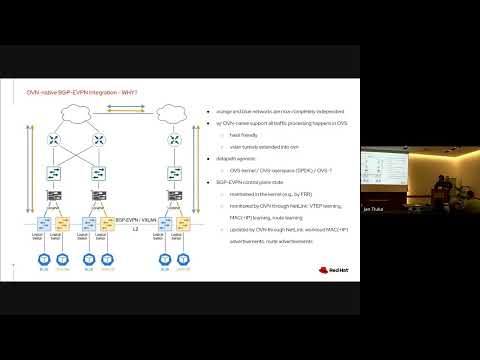
- Why: OVN deployments have historically been islands attached to the physical fabric through gateways or external controllers. With native BGP in 25.03 and experimental BGP-EVPN in 25.09, OVN logical L2 domains now stretch directly into and across the DC fabric — the concrete mechanism by which the overlay joins the EVPN fabric.
- What: OVN-native EVPN support: a provider logical switch's L2 domain is extended across an IP fabric via VXLAN, with the BGP-EVPN control plane (run by FRR) distributing MAC/IP (type-2) and, planned for 26.03, type-5 routes. OVN learns remote VTEPs, remote FDBs, remote IPs (with ARP suppression) and remote routes; it advertises local workload MACs/IPs, connected networks and NAT IPs back into the fabric. L2 EVPN is implemented and experimental in 25.09; L3 EVPN per-VRF is the 26.03 plan.
- How: The CMS pre-configures
br-$vni/lo-$vni/vxlan-$vniinterfaces in the default network namespace; OVN monitors FRR/zebra state via NetLink and programs the OVS datapath: per-VTEP OpenFlow cookies on br-int,tun_id/tun_src/tun_dstloads,learn()actions with 30s hard timeouts for dynamic FDBs, and ARP-suppression flows on logical routers. Configuration is per logical switch viadynamic-routing-vniplusovn-evpn-local-ip. - Where applicable: Any OVN deployment needing L2/L3 fabric extension; datapath-agnostic (OVS kernel or DPDK) and hardware-offload friendly since VXLAN is terminated in OVS. Constraints: at most one local IP per EVPN tunnel today, fixed host-side interface naming (fine-grain naming is an open question), needs FRR on OVN nodes, and it is explicitly experimental with the authors soliciting design feedback.
Multiple NICs as Encapsulation Endpoints for Large Scale GPU Cloud#
Girish Moodalbail (NVIDIA), Han Zhou (NVIDIA)

- Why: In GPU servers each GPU typically has a dedicated NIC (4 GPUs = 4 NICs), so inter-node AI training traffic is multi-homed and each NIC's IP becomes an encapsulation endpoint — while vanilla OVN assumes one encap IP per chassis. This is the scaling problem AI clouds are hitting right now, and it lands squarely in physical DC / scale territory.
- What: Multi-NIC encap endpoint support in OVN/OVN-Kubernetes: per-VIF selection of source/destination encapsulation IPs, full-mesh tunnels (all local × all remote encap IPs), new flow programming using an Encap-ID in
REG13[16..31], and host-side routing fixes for both the kernel and OVS-DPDK paths. Special cases are handled: distributed gateway ports (skip pinning or fall back to default encap) and ovn-ic transit-switch ports (proposal: multiple TS-LR ports plus/32routes and a newrequest-encap-ip). - How:
ovn-encap-ipcarries a comma-separated IP list; per-interfaceencap-ipexternal_ids drivePort_Binding:Encapin the SB DB, populated by ovn-controller. The kernel path needs source-based policy routing plusrp_filter/arp_ignore/arp_announcesysctls; the DPDK path required an upstreamed OVS multi-table routing fix (ovs-router). Egress flows scale O(E×P) — local encap IPs × remote port bindings. - Where applicable: Demonstrated on NVIDIA GPU cloud / cloud gaming topologies, but the mechanism is generic OVN. Scale is the open issue: 8 NICs × 1000 chassis ≈ 64k tunnel ports per node, which stresses ovs-vswitchd. Mitigations proposed but not yet landed: flow-based tunnels (loses IPSec/BFD), a "Transport Plane" grouping that cuts 64→8 tunnels per node (87.5% fewer), and intra-node tunneling to preserve HW offload across NICs.
The BGP Fork in the Road: A Tale of Two Implementations#
Jaime Caamaño Ruiz (Red Hat), Patryk Diak (Red Hat), Surya Seetharaman (Red Hat)
- Why: Two BGP implementations were built in parallel — OVN's native dynamic routing and OVN-Kubernetes' FRR-k8s integration — and whether they converge determines how K8s clusters exchange routes with the provider network. BGP internals are squarely in the PM's interest set.
- What: A side-by-side anatomy. OVN: BGP-daemon-agnostic ("bring your own FRR"), routes exchanged through kernel VRFs over NetLink, with
Advertised_Route/Learned_Routetables in the OVN DB; by default the VRF carries control-plane traffic only and the host routing table is untouched;dynamic-routing-vrf-idfrees the VRF table ID from the datapath tunnel key. OVN-Kubernetes: aRouteAdvertisementsCR generatesFRRConfigurationfor FRR-k8s; in Local Gateway mode a VRF is in the data plane, in Shared Gateway mode BGP-learned routes are copied into OVN gateway routers. Then the gap list for adopting OVN's native BGP: table-ID collisions, distinct vs shared VRFs, default VRF support, filtered learning, real next hops instead of blackhole routes, and per-LSP/per-LB/32advertisement. - How: Concrete merge path proposed: CMS-managed table IDs (already landed in controller/northd), shared VRFs as the more efficient but harder option needing extra OVN support (filtered learning, actual next hops on advertised routes).
- Where applicable: OVN-Kubernetes / OpenShift clusters peering with provider networks. The merge is a proposal, not a done deal — this is an honest gap analysis, not an announcement.
Transit router - The distributed router for OVN interconnect.#
Ales Musil (Red Hat), Mairtin O'Loingsigh (Red Hat)

- Why: OVN interconnect (ovn-ic) previously offered only a Transit Switch; there was no simple way to route between Availability Zones. The Transit Router fills that gap as a distributed logical router spanning AZs — and it already underpins the OVN-Kubernetes Layer2 re-architecture (see the upgrade talk below).
- What: A logical router instantiated across AZs in an ovn-ic deployment, behaving like OVN's distributed routers; new
ovn-ic-nbctlverbs (tr-add,trp-add,trp-del,tr-list); per-AZ ARP learning with ARP responses flooded between AZs via specially added flows. The deck includes a full packet-level walkthrough (SNAT on the gateway router, Geneve tunnels between chassis,lr_in_ip_routingflow selection). - How:
tr-addallocates a unique datapath tunnel key, delegates the ICSB datapath binding, and creates a router in each AZ;trp-addassigns resource allocation per AZ, creates logical router ports, and syncs port binding tunnel keys. - Where applicable: Multi-AZ OVN interconnect deployments, generic OVN. Open questions acknowledged: definition and synchronization of routes and route rules across the TR, and "local" TRP port semantics.
You Want to Upgrade WHAT? A Field Guide to Risky Network Changes#
Nadia Pinaeva (NVIDIA), Dumitru Ceara (Red Hat), Patryk Diak (Red Hat)

- Why: A rare, detailed production migration narrative: OVN-Kubernetes' legacy Layer2 UDN topology was redesigned around the OVN Transit Router while customers ran on it, with real failure modes and fixes documented — exactly the incident-detail-rich content worth a PM's time.
- What: The legacy L2 topology (node-specific gateway routers) broke VM live migration (stale ARP for the migrated gateway MAC; IPv6 RAs from multiple node gateways creating broken multipath defaults, worked around by iptables-blocking external RAs in every L2 pod), doubled maintenance for each new feature, and forced EgressIP hacks. The new topology makes a transit router the network's default gateway with the same IP and MAC on every node. The bulk of the talk walks the rolling upgrade through a half-old/half-new cluster, including hand-crafted routes and dummy IPs to bridge old and new gateway routers during the mixed state, and hand-crafted route advertisements to flush stale routes.
- How: Rolling per-node upgrade rewires topology while workloads are drained and rebooted; NAT moves through the transit router; explicit static routes (e.g.,
100.65.0.2 via 100.88.0.5) stitch the two topologies together. - Where applicable: OVN-Kubernetes Layer2 UDNs in production; the authors note it is based on actual joint debugging sessions across the OVN and OVN-Kubernetes communities. The migration playbook generalizes to any non-disruptive OVN topology change.
A Nightmare on Kube Street: Slicing Kubernetes Networks like Freddy Krueger#
Dave Tucker (Red Hat), Surya Seetharaman (Red Hat)

- Why: Kubernetes multi-tenant isolation is still flat; this talk brings cloud-provider VPC semantics to OVN-Kubernetes on top of User-Defined Networks — policy at the network-topology level rather than per-pod NetworkPolicy.
- What: A concept mapping of VPC constructs across AWS/Azure/GCP/VMware/OpenStack onto OVN-K8s (UDN = subnet, NetworkPolicy = security groups, OVN routers = route tables/T0-T1 gateways), then a new
ClusterNetworkConnectCR: a group of label-selected UDNs/cluster networks connected via shared supernet CIDRs (connectSubnetsper address family withnetworkPrefix), with explicit connectivity grants (PodNetwork, ClusterIPServiceNetwork). Working prototype demonstrated. - How: Label-based
networkSelectorsmatch UDNs/CUDNs; east-west traffic runs over Geneve, north-south SNATs pod IPs to node IPs; OVN logical switches/routers/policies provide the segmentation. - Where applicable: OVN-Kubernetes clusters needing self-service team networks with platform-team-controlled inter-network communication. Prototype-stage, but with clear forward hooks already named: RouteAdvertisements (BGP), EVPN to provider networks, and cloud-construct integration.
OVN-Kubernetes Meets DPUs: Enabling Service Function Chaining and Shared OVN#
Tim Rozet (NVIDIA)

- Why: Shows concretely how DPU adoption is driving new OVN features — SFC and "Shared OVN" — i.e., where the OVN architecture is heading for offloaded security/auditing pipelines, with an explicit call for contributors.
- What: An SFC design for OVN (RFC 7665 semantics): initially SFC-unaware service functions (no NSH), using Geneve to carry chain metadata between nodes; a new
Service_Function_ChainNB table with two modes —local(no conntrack, allows packet modification, all SFs on one chassis, symmetry requires an explicit reverse chain) andimmutable-global(conntrack-implied symmetry, chain can cross nodes, no packet modification);Network_Function_Groupgains aload-balancemode for multiple SF instances. Shared OVN: one OVN instance serving multiple CMSs — one per DPU plus one for the host cluster — with RBAC separation. - How: A two-cluster DPU model (Kubernetes running on the DPU) lets DPU admins enforce security at the edge by injecting SFC classifiers as ACLs into the host cluster's traffic; open questions stated plainly — is OVN RBAC secure enough for this, and does shared OVN actually reduce resource consumption?
- Where applicable: OVN-Kubernetes on BlueField-class DPUs; enhancement proposal under active discussion (June 2025 ovs-dev thread); single-cluster SFC targeted first, shared two-cluster second.
Baremetal network isolation for cloud providers with OVN on DPUs#
Adrian Chiris (NVIDIA), Mael Kimmerlin (NVIDIA), Tarek Abu-Hariri (NVIDIA)

- Why: Secure multi-tenancy for bare-metal cloud nodes without per-tenant switch configuration — the DPU is the enforcement point a tenant cannot reach even with privileged host processes. Combines the PM's physical DC and network security interests, and it ships real throughput numbers.
- What: OVN/OVS offloaded to BlueField-3 and run in a separate trust domain under cloud-admin control; tenant VPCs (bridged L2 networks with DHCP, masquerade, external routing, floating-IP-class features) enforced transparently to the host, with declarative Kubernetes CRDs (
DPUVPC,DPUVirtualNetwork,DPUServiceInterface) mapping bare-metal machines to tenants dynamically. Test results: node-to-node RoCE with Geneve encapsulation on BF3 with 2×200Gb/s links — 191.9 Gb/s without ECMP, 383 Gb/s with ECMP (BGP to an L3 ToR, single hop, OVS-based HBN router). - How: An OVN logical structure modeled on OVN-Kubernetes, optimized for bandwidth and few hops; isolation at the PF/VF level; ECMP via BGP; HBN (host-based networking) OVS router on the DPU.
- Where applicable: NVIDIA BlueField-3-specific. Roadmap includes OVN-IC, BGP-EVPN integration (replacing the external router with OVN BGP), SFC, and nested OVNs; the multi-tenancy API is currently admin-only. Real numbers, but from the vendor's own testbed.
Virtual Network Function integration in OVN#
Sragdhara Datta Chaudhuri (Nutanix), Naveen Yerramneni (Nutanix)

- Why: Inserting third-party firewalls / network functions into the OVN traffic path has been a long-standing gap; this is a concrete, code-in-review design for bump-in-the-wire service insertion — network security chaining at the OVN layer.
- What: ACL-matched traffic is steered through a VNF's port pair (inline mode) or cloned to the VNF (tap mode); stateful symmetry via conntrack labels; VNF groups with datapath-probe health monitoring; member selection or load balancing across healthy members; configurable fail-close vs fail-open when all members are unhealthy; enforced tunneling for cross-host traffic to and from the VNF's node. Supports active/standby now, active/active planned.
- How: New logical-switch pipeline stages, new NB entities for network functions, a new ACL action, a new ovn-controller health-monitor type; conntrack labels redirect response packets and enforce tunnel behavior.
- Where applicable: OVN with either VLAN or overlay subnets, vendor-agnostic VNFs. Status: patch series in code review (July 2025 on ovs-dev). Note: the slide deck is mostly diagrams with no extractable detail, so this write-up is grounded in the abstract only.
Revisiting checksum offloads in OVS#
David Marchand (Red Hat)

- Why: The userspace (DPDK) datapath's checksum/TSO API had grown buggy and tightly coupled to DPDK; this is a full revamp with per-NIC performance numbers — directly relevant to high-throughput OVS on real hardware.
- What: The OVS 3.6 redesign: a new
dp_packet::offloadsfield with four-state (unknown/bad/good/partial) Rx statuses for IP and L4, tunnel encapsulation expressed as status metadata, and TSO reduced to atso_segszvalue. Massively expanded unit tests caught real bugs (simple-match checksums, IPv6 UDP, conntrack ICMP-embedded checksums, IP fragmentation handling). OVS 3.7 adds an outer-UDP-checksum optimization: for valid inner IPv4/TCP, the outer UDP checksum equals the inner checksum sum, so it can be derived rather than computed — plus "partial segmentation" so HW TSO packets can use it. - How: Inner/outer statuses split via a 16-bit shift; netdev drivers (netdev-dpdk) translate OVS statuses into mbuf Tx flags, isolating OVS core from DPDK/kernel APIs. Measured on mlx5 CX-6 Dx: Geneve TCP 6.08 → 7.31 Gbit/s from the outer-UDP optimization, and 7.3 → 10.4 Gbit/s at 37% CPU once HW TSO works; comparative numbers across CX-6 Dx, X710 and E810, including which NICs lack outer UDP checksum offload entirely.
- Where applicable: OVS userspace/DPDK datapath; behavior is NIC-specific and the feature is still marked experimental (the talk asks whether to change that). The CX-6 Dx gap found here directly feeds the VDUSE talk's benchmark findings.
OpenFlow Classifier: Arcane knowledge and common pitfalls#
Ilya Maximets (Red Hat)

- Why: The classifier is the hottest path in OVS and determines megaflow quality, which drives datapath autonomy and flow-cache effectiveness. Understanding its subtable model explains OVN pipeline performance and recent regressions and fixes — core datapath-internals material, delivered by a current maintainer.
- What: A deep dive: rules are grouped by match pattern into per-mask hash "subtables"; lookup iterates subtables ordered by the highest priority they contain; complexity is O(1) per subtable hit and O(n) over distinct masks. "Un-wildcarding" produces the megaflow mask — false 1-bits are allowed but degrade caching; false 0-bits are correctness bugs. Optimizations covered: staged lookup (the mask split into 4 segments with early exit, sharply reducing un-wildcarded bits for non-matching packets) and prefix tracking. Pitfalls: mask explosion from many distinct match patterns, and historically from OVN's inequality matches (single-bit masks, fixed October 2025 to use prefixes; IPv6 address pairs can still theoretically yield 128×128 masks).
- How: Practical do/don't guidance for OpenFlow pipeline authors: match earlier-stage fields alongside later ones where logic permits, never let struct flow dependencies cross segment boundaries, and avoid generating fragmented masks.
- Where applicable: Every OVS deployment; especially relevant to OVN logical-flow generation and anyone reading megaflow traces.
Adjacent#
Beam Me Through the Datapath: VDUSE for OpenShift Virtualization#
Jakob Meng (Red Hat), Maxime Coquelin (Red Hat)

- Why: Completes a fully-userspace datapath (OVS-DPDK + VDUSE) for KubeVirt VMs, with unusually transparent benchmarking that includes cases where DPDK loses to the kernel datapath.
- What: Extends last year's container userspace work to VMs via VDUSE/vhost-vDPA (primary and secondary networks), plus new workload-partitioning knobs in OpenShift (
strict-cpu-reservation, dedicatedCPUSet,irqbalanceBanned, static PMD masks). Benchmarks (Xeon Silver 4310, CX-6 Dx, OVS 3.5+): OVS-kernel outperforms OVS-DPDK on large TCP buffers; small-buffer throughput improves withpmd-sleep-max(~90,000 → ~3,000 IRQs/s, QEMU 200% → 115% CPU at 128B buffers) at the cost of large-buffer performance; a virtio-net IRQ-coalescing prototype in the DPDK vhost library fixes that without sleeps. Also documents CX-6 Dx lacking outer-UDP checksum offload (which forced software segmentation — tying into the checksum-offload revamp) and KubeVirt's fixed 256-descriptor virtio rings. - How: VDUSE is a purely software vDPA device implemented by a userspace application (the OVS DPDK vhost backend), attached through the vDPA bus; vhost-vDPA serves QEMU.
- Where applicable: OpenShift Virtualization, telco and real-time use cases. Preliminary results, explicitly framed as transparent benchmarks; the partitioning APIs are OpenShift-specific but the datapath work is upstream OVS/DPDK.
Observing Open vSwitch with native prometheus metrics#
Gaetan Rivet (NVIDIA)

- Why: OVS observability today depends on external exporters that assume the kernel datapath and scrape CLIs; a native exporter unifies kernel and userspace observability with lower footprint — practical for anyone running OVS at scale.
- What: A Prometheus-compatible metrics framework inside the OVS library: counter/gauge/histogram types, and a per-process metrics tree whose internal nodes mirror module structure (datapath cache/conntrack/offloads, interfaces, memory, ofproto). Node types cover subsystems, labeled collections (FOREACH), bounded collections for label generation, and conditionals (e.g., offload metrics only when
hw-offloadis on). Exposed via anovs-exportersystemd service (default port 6103),ovs-appctl metrics/show, and Python bindings; new metrics appear automatically without new CLI plumbing. - How: The tree is statically defined (API in
lib/metrics.h), interpreted at scrape time, and rendered into the Prometheus text model — the design is deliberately output-format-agnostic so other formats could follow. - Where applicable: OVS kernel and userspace datapaths alike; initial coverage: resource consumption, interface counters and link state, ofproto upcalls/revalidation, and coverage counters. Complements (rather than competes with) DOCA-Telemetry on NVIDIA kit.
OVS-DOCA live-upgrade#
Eli Britstein (NVIDIA)

- Why: Upgrading ovs-vswitchd in production today means a full daemon restart — losing conntrack state (dropping TCP sessions), FDB, meters, groups, TLV-map, configured routes, and tunnel neighbor tables, plus re-initializing ports with offloads. A zero-downtime model matters for any DC or carrier SLA.
- What: OVS-DOCA achieves in-place upgrades by starting the new version in client mode alongside the running server: the server keeps forwarding while the new instance initializes ports and offloads in parallel; volatile state is migrated to the new instance; then a zero-time handover and server termination. Version and resource constraints, failure handling, and rollback are addressed.
- How: DOCA can initialize the same ports from different userspace processes and hand over between them with zero interruption.
- Where applicable: OVS-DOCA (NVIDIA's downstream OVS) on ConnectX/BlueField — not upstream OVS today. The state-migration problem it solves, however, is universal for production OVS. (from abstract only; the slide deck could not be extracted and the program page adds nothing beyond the abstract)
OVS-DOCA upstream roadmap#
Maor Dickman (NVIDIA)

- Why: Signals where hardware offload in upstream OVS is heading: NVIDIA is moving DOCA acceleration from a downstream fork into upstream via the dpif-netdev framework, which means new upstream OVS APIs (dpif-offload-provider, userspace CT offload).
- What: The plan: a new
netdev_docanetdev class (port initialization and software slow path under dpif-netdev), a newdpif-offload-docaprovider (offloading megaflows, based on a new dpif-offload-provider API), and a new connection-tracking offload API for the userspace datapath. Gaps are acknowledged: eswitch hierarchy (one port handling all device ports), port-init ordering, partial offload (HW-to-SW miss path), and advanced offloads (sFLOW, tunnel entropy, meters, DP_HASH). This replaces the earlier dpif-netlink-based DPIF-DOCA direction. - How: Staged upstreaming steps are enumerated: offload-provider first, then the netdev, then dpif-offload-doca, then agreement on the CT offload API. DPIF-DOCA will live as a standalone open-source library while DOCA-Flow/DOCA-Eth remain closed-source.
- Where applicable: ConnectX/BlueField with the OVS userspace datapath. Vendor roadmap — but with concrete architectural consequences for upstream OVS; watch the dpif-offload-provider and CT-offload API discussions if you care about offload in OVS.
Turbocharge Kubernetes with offloaded OVN-Kubernetes and OVS on DPUs#
Alin Serdean (NVIDIA), Amit Zala (NVIDIA), Mael Kimmerlin (NVIDIA), Igal Tsoiref (Red Hat)

- Why: A production-oriented, DPU-offloaded Kubernetes platform (DPF) with benchmark numbers — and a notable strategic shift: OVN-Kubernetes is moving upstream-first, reviving DPU-host mode after roughly two years dormant.
- What: DPF (DOCA Platform Framework) manages DPU fleets declaratively: DPUSet provisioning (BFB images), DPUService/DPUServiceChain lifecycle via ArgoCD, version-compatibility gating, and rollout-velocity budgets; service chaining runs an OpenFlow controller patch-paneling OVS ports on the DPU; OVN-Kubernetes runs in DPU mode with hardware acceleration for workload pods alongside HBN. Measured 354.92 Gbit/s iperf3 between pods across two BF3 nodes through HBN plus the service chain. Future work: OVN-K as the DPU cluster's primary CNI (dropping Flannel), 2+ OVN-K instances per host, RDMA-accelerated traffic in OpenShift, and selective pod offloading instead of "offload everything".
- How: Two-cluster model — host cluster plus DPU clusters run as HyperShift hosted control planes; RHCOS brought to BlueField via a custom coreos-installer flow; the SC CNI stamps DPF service metadata onto OVS ports so the chaining controller can create patch-panel rules.
- Where applicable: NVIDIA BlueField-3 + OpenShift. Treat the numbers as vendor-reported (some slides were marked NVIDIA confidential) — but the OVN-Kubernetes upstream-first shift, DPU-host-mode revival, and the OpenShift integration challenges (CNO, security model, RHCOS) are genuine engineering signal.
Space - building a CMS with OVN Concepts#
Felix Huettner (StackIt)

- Why: An end-user case study of a cloud provider whose requirements (policy-based routing combined with dynamic routing, deny ACLs, per-ACL logging) outgrew Neutron — and who, rather than replacing OVN, built a custom CMS layer on OVN design concepts.
- What: "spaced", a Go daemon using ovn-kubernetes' libovsdb, translating a custom "spacebound" OVSDB schema into the standard OVN northbound DB — effectively a custom northd. It coexists with Neutron through per-table resource ownership (either Neutron or spaced writes a given NB table), with a full migration off Neutron as the long-term goal.
- How: Sticks to OVN's layered model (NB/SB/northd/ovn-controller), inserting spaced between the CMS and NB; the processing engine is modeled on OVN's incremental-processing engine (not yet implemented). Challenges listed honestly: libovsdb is event-driven with no consistent-state reads, no automatic reference resolution, and no change tracking.
- Where applicable: StackIT / Schwarz Digits' OpenStack+OVN production environment — org-specific, but a useful template for anyone considering building a CMS directly on OVN primitives instead of adopting a full CMS.
Programming OVS bridges using OVN Bridge Controller#
Numan Siddique (Crusoe AI)

- Why: New in OVN 26.03 (merged the week before the conference): program any OVS bridge using OVN logical-flow syntax instead of raw OpenFlow — motivated by a real end user (Crusoe) that needed to program provider bridges after the OVN pipeline.
- What:
ovn-br-controllerplus a new OVN Bridge OVSDB database; the CMS writes logical flows (bridge, table, priority, match, actions) and the controller compiles them to OpenFlow exactly as ovn-controller programs br-int. It injects physical mapping flows (loading interface ofports into registers, a NORMAL fallback) and translates logical actions into concrete rules; multiple bridges per host are supported. - How: Per-hypervisor services started via ovn-ctl;
external_ids:ovn-br-remotepoints the controller at the ovnbr DB; anovn-brctlCLI handles bridge and flow creation. - Where applicable: Anyone programming provider/physical bridges on top of OVN-based stacks. Current limitations are stated: no restriction against adding br-int, and OVN-specific controller actions (put_dhcp_opts, put_fdb) are not yet restricted; incremental processing and code-sharing with ovn-controller are future work.
Wildcard#
OvS and Socket Maps - Beyond ports as endpoints#
Aaron Conole (Red Hat)

- Why: A genuinely surprising datapath idea: treat application sockets as packet endpoints and skip the IP stack entirely. Measured ~1000ns of 7395ns per-packet protocol overhead in netns-to-netns forwarding — relevant to anyone watching eBPF/XDP-style bypass techniques reach general SDN tooling.
- What: An exploration with four prototype approaches (in-datapath table, userspace-centric, eBPF-based, plus a socket-map variant), with numbers: 7395 → 6190ns per packet (and ~23k more 65k-packets/s) using a
sock(try)action to skip conntrack; the socket-map-style approach measured 8254ns — essentially identical to plain output, reported without spin. Difficulty is candidly labeled "very much a nightmare": tracking sockets across netns boundaries and rewriting recirc state. Preliminary patches are posted; the direction is undecided. - How: OVS already knows the destination socket from tuple/conntrack state;
sock()actions would enqueue directly to application sockets, skipping L3 routing and re-parsing inside the target netns, while trying to preserve OVS's flow-centric (megaflow) semantics. - Where applicable: OVS kernel datapath with local (same-host) endpoints; experimental RFC stage (June 2025 ovs-dev thread). The eBPF variant is described as the most future-proof but hardest to integrate with OVS userspace.
When CI Shouts Back: LLMs in the OVS CI Pipeline#
Aaron Conole (Red Hat)
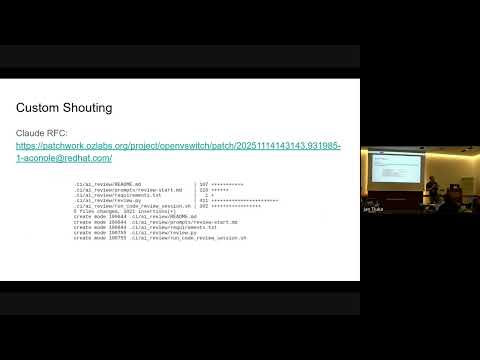
- Why: Not networking — but a clear signal of where core infrastructure projects are heading: LLM-assisted code review inside the OVS CI pipeline, with the friction reported honestly rather than sold.
- What: Experiments with CodeRabbit, Sourcery, and Claude SONNET-class models on OVS patch review. Findings: PR-based bot workflows fragment patch discussion into a second venue, branches must be kept very tightly in sync, and bots contradict themselves between runs ("suggest doing one thing then doing another"). A custom Claude-based reviewer (RFC on patchwork) offers own prompts, developer-runnable execution, and GitHub Actions integration — at real dollar cost.
- How: PW-CI infrastructure changes plus custom prompting instead of SaaS review bots.
- Where applicable: OVS CI specifically, but the lessons (bot consistency, cost, review-venue splitting) generalize to any patch-based OSS project evaluating review bots.
AI-Powered Performance Insights: Integrating OVS/OVN automatic performance regression analysis with LLMs#
Joe Talerico (Red Hat), Jose Castillo Lema (Red Hat), Mohit Sheth (Red Hat)

- Why: Shows how performance engineering for Kubernetes networking is being automated and made LLM-queryable — shift-left performance testing operating at real scale, with coverage numbers rather than claims.
- What: Red Hat Perf&Scale's continuous performance testing: benchmarks (k8s-netperf, ingress-perf, cluster-density-v2) run against PRs early; Orion, a Python library doing automated statistical regression detection (Apache Otava e-divisive change-point detection) over an Elastic/OpenSearch data warehouse; and Orion-MCP, an MCP server that lets LLMs answer "has my PR regressed OpenShift?", correlate regressions with PR changelogs, and surface version-tagged results (OVN, OVN-K, OVS versions per run). Scale: 5 platforms (AWS, Azure, GCP, IBM, bare metal, plus ROSA/ARO), 100+ weekly tests; 2025 added net-new workloads for UDN L2/L3, Virt UDN, NetworkPolicy, EgressIP and BGP, with 30+ downstream bugs filed.
- How: Fingerprint-based result retrieval (platform, node types/counts, benchmark,
networkType: OVNKubernetes), change-point detection on the matched series, and MCP tool calls surfaced through Slack (GitHub integration next). Next steps: agentic AI for CPT and pushing a perf workload into ovn-ci upstream. - Where applicable: OpenShift/OVN-Kubernetes development workflow; Red Hat-internal tooling, but the Orion + Orion-MCP pattern is directly replicable by any team with a benchmark data warehouse.
Themes#
- OVN is growing into the physical fabric. Native BGP (25.03), experimental BGP-EVPN (25.09, L3 EVPN planned for 26.03), and the Transit Router for inter-AZ routing all landed within a year. The overlay/underlay boundary in OVN deployments is dissolving — fabric integration is becoming an OVN-native capability rather than an external-gateway problem.
- DPU and hardware offload work is moving upstream. Four DPU talks (baremetal isolation, OVN-K DPU mode, SFC/Shared OVN, DPF) plus the OVS-DOCA upstream roadmap: offload architecture is being reworked into upstream OVS APIs (dpif-offload-provider, userspace CT offload) instead of living in vendor forks. Watch the OVN SFC and Shared OVN enhancement proposals — they define the next two release cycles.
- AI/GPU workloads are reshaping overlay requirements. Multi-NIC encapsulation endpoints, 64k-tunnel scale limits, RoCE-over-Geneve benchmarks, and RDMA enablement roadmaps: AI infrastructure is stress-testing overlay designs designed for one encap IP per chassis.
- Kubernetes multi-tenancy is converging on cloud-provider VPC semantics. UDNs, ClusterNetworkConnect/VPC grouping, EgressIP and RouteAdvertisements are all landing on OVN logical-topology primitives — K8s networking is catching up to AWS/NSX isolation models.
- Unusually honest results culture. Several talks publish negative or preliminary numbers openly (userspace DPDK losing to the kernel on large buffers; the socket-map approach measuring no better than plain output) alongside a production migration war story with real failure modes. Good signal quality for a vendor-adjacent event — weight these over the pure demo talks.
- LLMs are entering the project maintenance loop. CI code-review bots (with their inconsistencies) and MCP-driven performance regression analysis both appeared this year — early, imperfect, and worth tracking as an emerging subfield.
- Zero-disruption operations are the new battleground. OVS-DOCA live-upgrade with state migration and the OVN-K rolling topology rewire both tackle the same problem: changing the dataplane without dropping traffic — historically the weakest point of OVS/OVN in production.
About this digest
ToFaRev picked and wrote this digest on Nebius Token Factory, from the conference's published program. A person reviewed it in a pull request before it was published. Write-ups marked "from abstract only" had no fuller source to read. Source: digests/ovscon-2025.md · prompt: prompts/ovscon-2025.md