Toward Host-Pluggable Congestion Control for RDMA/IP Datacenter Transports#
Netdev 0x1A (Rome, 13-16 July 2026) digest Program Core pick Rome · 13–16 July 2026
Vivek Kashyap
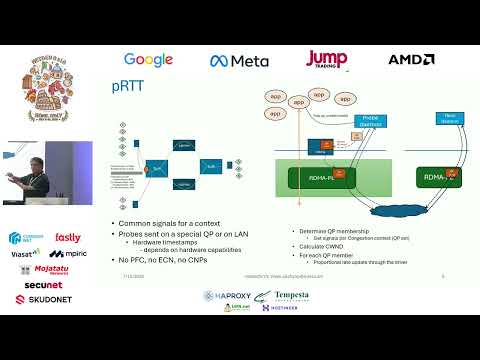
Why: RDMA congestion control is stuck in NIC firmware, which means every algorithm change is a vendor release. Breaking that open is the difference between DCQCN/PFC-shaped fabrics and fabrics you can actually tune per workload.
What: A working implementation of host-driven RDMA congestion control that runs with NIC-embedded congestion control disabled and without relying on DCQCN/PFC behaviour.
How: A host component (userspace or kernel) periodically sends probe packets, uses hardware timestamping to get path RTT, converts that into a per-path congestion estimate, then distributes the resulting control value across the active Queue Pairs for that peer via a driver-mediated QP update interface. The author is explicit that probe RTT is a deployable starting signal rather than the right one, and that the same framework could take ECN counts, ACK/progress counters, retransmit events and path-health indicators. (From abstract only.)
Where applicable: RDMA/IP datacenter fabrics carrying mixed traffic — AI collectives, storage, KV-cache movement, HPC, front-end — where one fixed firmware algorithm is a poor fit for all of them. Needs driver support for the QP update interface, so vendor cooperation is still on the critical path.