Promise Networks: Why a Bilateral Link Layer Solves Congestion Control at the Source#
Netdev 0x1A (Rome, 13-16 July 2026) digest Program Wildcard pick Rome · 13–16 July 2026
Anjali Singhai-Jain, Chihjen Chang, Paul Borrill, David Zage
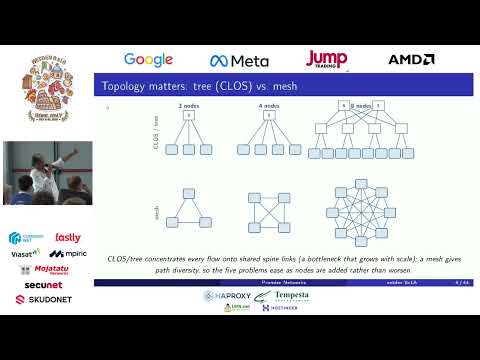
Why: A deliberately foundational challenge to the entire congestion-control framing, presented for community critique — and the kind of argument that either goes nowhere or reshapes the debate in five years.
What: The proposal that packet drops are not necessary at datacenter scale, and that congestion control belongs in the link layer as an admission discipline rather than above it as a feedback loop.
How: Open Æthernet generalizes the "end-dally" bilateral closure from Metcalfe and Boggs's 1976 EFTP into a link-layer primitive where every frame is gated on a peer-issued token — a sender without a token cannot transmit, so uninvited frames never enter the fabric. Framed via Promise Theory, with a sketch of the Linux kernel surface it would need. Same authors' companion talk applies the identical argument to the syscall boundary. (From abstract only.)
Where applicable: Nothing deployable — an explicit moonshot needing new link-layer hardware semantics. Read it for the framing of drops-as-design-choice at million-node scale.