Accelerating Software RDMA (RXE) with Netkit and Devmem#
Netdev 0x1A (Rome, 13-16 July 2026) digest Program Core pick Rome · 13–16 July 2026
Yanjun Zhu
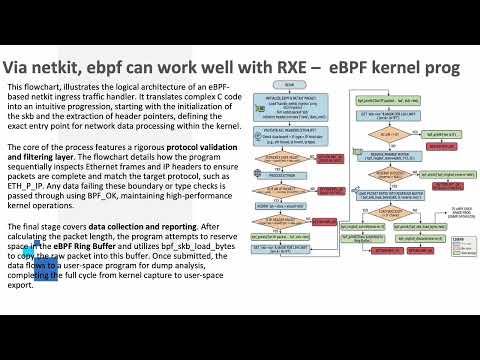
Why: It wires together three things this PM tracks separately — netkit (the Cilium-era container device), devmem TCP/dma-buf, and software RDMA — into one datapath, and it targets the container/namespace case rather than bare metal.
What: A shortened RXE (Soft-RoCE) datapath that uses netkit as a fast-path transport hook, plus devmem TCP integration for true end-to-end zero copy and an eBPF-based visibility layer.
How: Today RXE encapsulates RoCEv2 in UDP/IP, so same-host inter-namespace traffic traverses routing lookups, Netfilter and redundant copies. Hooking netkit's native TX/RX bypasses the IP layer entirely, giving a claimed 10-20% same-host latency reduction in namespace environments (proportional to how much routing/firewall complexity is skipped). Layering devmem TCP and dma-buf on top — with hardware queue leasing/splitting from the physical NIC (e.g. ConnectX-6) — lands payloads directly in device (GPU) memory. For observability, instead of kprobes or driver patches, an eBPF program on netkit's tcx hook parses RDMA headers (BTH etc.) into a ring buffer for PCAP dumping. Presented with a live demo across namespaces based on kernel selftests. (From abstract only.)
Where applicable: Containerized RDMA, particularly where zero-copy hardware RXE support is absent. The devmem half needs a NIC supporting queue leasing and a dma-buf provider, so treat the "100% zero copy" claim as hardware-conditional.