Keynote: AI Data Center Networking: Lessons from Meta's Evolution#
NANOG 96 digest Program Core pick 2–4 February 2026
Omar Baldonado — Meta
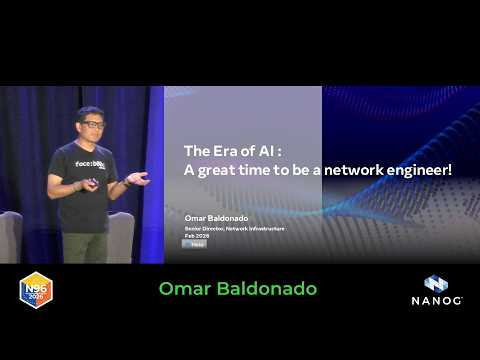
- Why: Meta operates some of the largest AI clusters in the world and, unusually for a hyperscaler, shares openly (FBOSS, TorchComms, OCP). A cross-generation retrospective on AI fabric design from the person who runs Meta's global DC networks is the highest-signal keynote on the program for physical DC networking.
- What: A retrospective through successive AI network deployments — what each iteration taught and where false starts occurred — framed as a stack: PyTorch/framework behavior shapes xPU selection, accelerator traffic patterns drive topology choices, NIC capabilities enable or constrain operations. Also covers network automation at scale, density constraints (power, cooling, space), telemetry for AI workloads, and managing rapid technology transitions without destabilizing production, with gigawatt-scale clusters on the roadmap.
- How: Lessons-learned format across production generations rather than a single architecture pitch; the value is in the cascade framing (framework → hardware → topology → operations) and the operational truths behind open-sourced artifacts like FBOSS and TorchComms.
- Where applicable: Explicitly Meta-scale — multi-gigawatt buildouts, custom switch OS, OCP hardware. The layer-interaction reasoning transfers to anyone designing AI clusters, but the specific density and automation numbers are org-specific (from abstract only; the NANOG content page could not be retrieved and no slides were published in the source material).