Understanding and optimising transceiver efficiency using internal metrics for improved power savings#
DENOG 17 (Essen) digest Program Core pick Essen · 9–11 November 2025
Dr. Gerhard Stein (FLEXOPTIX Research)
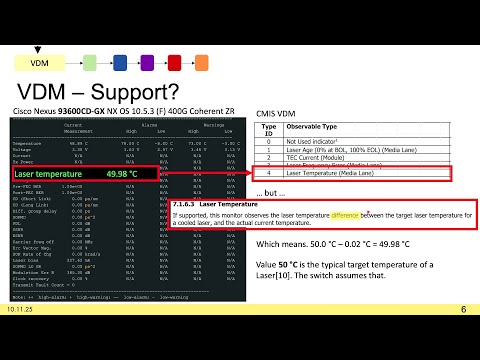
- Why: Power consumption of optics is becoming a first-order constraint in DC operations. This talk provides real measured data on transceiver power behavior using VDM (Versatile Diagnostics Monitoring) — directly relevant to the PM's optics and DC efficiency interests.
- What: An empirical study of transceiver power efficiency using CMIS VDM metrics (TEC current, laser temperature, optical power) across multiple transceiver types (100G QSFP28, 400G QSFP-DD ZR, 800G QSFP-DD) and switch platforms (Cisco Nexus 93600CD-GX, C9500, Juniper QFX5120). Key finding: laser and TEC power draw is negligible — the real energy consumers are the MCU/DSP. Shutting a port forces low-power mode with 7–20× less energy.
- How: VDM (from CMIS spec) exposes per-transceiver laser temperature, TEC current, and optical power via memory pages 20h–2Fh. Software prototypes collect and visualize this data in Watts. Experiments include frozen transceivers (ice cubes!) to isolate TEC behavior — finding ~200mW average increase per 20°C temperature difference. Switch-level power measurement complements module-level VDM data.
- Where applicable: Any operator deploying 100G+ optics who wants to measure and optimize per-port power. VDM support is spotty across switch platforms (Juniper QFX5120 and Cisco C9500 don't support it; Nexus 93600CD-GX does). The measurement technique is general; the specific "TEC/laser is negligible" finding is hardware-class-specific.