AutoCon 3 (Prague) — Operator#
A network-automation operator conference. Little here is directly about DC fabrics or identity protocols, but a strong subset is: two unusually candid optical-transport automation stories, a BGP telemetry build, a large-scale datacenter Terraform migration, EVPN service migration at a global telco, and several security/identity-flavored automation sessions. The rest is a clear field-wide shift from "automate operations" toward "design-driven, durable-execution, trustworthy automation" — worth skimming for where the networking discipline is heading.
Operator May 28, 2025 – May 30, 2025 Program
Core#
From Clicks to Code: Optical Network Automation Journey at GARR#
Matteo Colantonio, GARR (Italian research and education network)

- Why: Physical-layer transport (optical circuits, transponders, ROADMs) is the least-automated part of most networks, and this is a rare honest account of why the usual automation stack fails there and what actually works. Directly relevant to anyone with DC/WAN interconnect responsibilities.
- What: GARR's progression from Ansible/AWX and the vendor controller's northbound API to a workflow-orchestrator architecture that talks directly to optical devices, now in early production use.
- How: Ansible handled basic transponder upgrades but collapsed on complex
logic — restarting cards one-by-one and verifying service recovery required
three nested YAMLs with
includestatements. The vendor controller API was a stripped-down version of the GUI: missing key features, and useless for circuits crossing multiple line systems (mixed-platform ROADM metro regions). The pivot: build abstract service models plus Python clients speaking the same southbound interfaces the vendor controller uses (RESTCONF, TL1 shell for ROADMs), separating intent from device-specific configuration. - Where applicable: GARR-specific in topology (research backbone, mixed optical platforms), but the lessons — vendor NBIs as a bottleneck, direct device control, incremental automation starting with critical services — transfer to any optical/WAN environment. The observation that optical networks' GUI-centric (not CLI-centric) history changes the automation starting point is a genuinely useful framing.
Coding for infrastructure is just coding, on how we moved from a script based model to an object oriented architecture#
Antonio Balmaseda & Alberto Villegas Erce, Roche
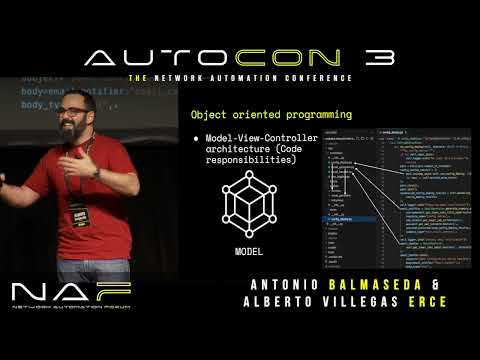
- Why: The second of two talks at this conference independently reaching the same conclusion about optical automation (Roche's optical network uses the same devices as ESnet and GEANT). Together they read as a mini-postmortem of Ansible-and-controller-based approaches to transport automation.
- What: Roche Pharma's move from scattered per-engineer scripts and Ansible playbooks to an object-oriented, model/controller/view architecture built on the Workflow Orchestrator framework, expected in production by the conference date.
- How: Abstract service models with Python clients talking directly to devices (RESTCONF, TL1 for ROADMs); hardware changes only require adding implementations via Python single-dispatch, giving clean boundaries between abstract intent and device config. Concrete results from the slides: 6000 backups in 20 minutes (down from 3 hours), and 200 devices patched unattended over a weekend with no CLI access. Massive changes now ship as a JSON file plus Jinja templates through a merge request.
- Where applicable: Roche-specific scale (worldwide multi-vendor network, thousands of devices), but the pattern — abandon YAML-nesting for real code when logic gets complex, keep Ansible only for what it's good at (backups, compliance, OS upgrades) — is broadly applicable.
Going beyond show commands and screen scraping with BMP#
Bart Dorlandt (freelance network automation engineer, Netherlands)

- Why: Verifying that BGP announcements you configured actually propagated and passed import policy is a classic gap; most shops do it with screen scraping. BMP (BGP Monitoring Protocol) is the right tool and this gives the architecture and the scaling numbers.
- What: A production pipeline for pre- and post-policy BGP data: router →
BMP collector → Kafka → consumer → database → API, replacing screen scraping
of
showcommands for customer-facing verification. - How: The initial consumer managed 30 msg/sec — nowhere near enough for millions of RIB entries — and was rewritten with a pool of async Kafka producers, reaching 45,000 msg/sec. Hard lessons: every stage (collector, consumer, DB) can be crippled by too much data, so filter early, deduplicate, and decide what you actually need; peer-down notifications are the critical code path; the BMP collector implementation used was incomplete and needed patches (Kafka TLS, Docker).
- Where applicable: Broadly applicable wherever BGP policy correctness needs verification (peering, DC fabrics, WAN). The pipeline is buildable from open components but the scaling numbers are one implementation's — treat 30→45k msg/sec as directional, not a benchmark.
The Road to EVPN: Automated Service Migrations#
Luke Gollan, Megaport

- Why: Migrating a live global network to EVPN with automated service cutover is squarely in the PM's EVPN/BGP and interconnect territory, and this covers the whole arc: architecture, config rollout, then customer service migration with minimal disruption.
- What: Megaport's end-to-end story of automated EVPN deployment across a global telco network, from design through rollout to migrating production services, plus customer/support-facing migration tooling.
- How: Object-driven database generating device configs; NETCONF operations to configure, log, and track changes; diversity zones to contain blast radius; APIs and message queuing to trigger migrations; explicit phased migration steps with rehearsed rollback; tooling to track network changes and keep business stakeholders informed. (From abstract only — no usable source text.)
- Where applicable: Megaport-specific (global NaaS/telco topology, dense service inventory), but the checklist — rehearsed rollback, diversity zones, event-driven migration triggers, stakeholder-visible risk — is a transferable migration methodology for any EVPN or fabric migration.
An Epic Journey: Automating networks with Terraform#
Eduardo Pozo

- Why: A concrete, numbers-backed account of Terraform at datacenter scale — including where it hurts (provider bugs, plan times, state risks) — which is rare and directly useful for DC automation decisions.
- What: Using Terraform as the primary automation tool across oil, health, and enterprise projects, including migrating a large multi-site datacenter to fully automated deployment.
- How: The slides quantify the pain: a 500+ leaf, 4-location, 2000+ VLAN
fabric; a full
terraform planagainst an empty APIC (Cisco ACI, ~5334 resources) took 45 minutes, cut to 19 minutes by moving data transformation (dedups viaset(), key lookups, validation) out of Terraform into Python. Honest coverage of vendor provider reality: "vendors say yes yes, it just doesn't work," API bugs, 12+ month-old issues, no CRUD — and the mitigations (contribute, pressure the vendor, hybrid approach, fork the provider). Also state loss/locking, apply-can-destroy surprises driven by provider quality, and preferring pipelines straight to infrastructure over controller-mediated paths where possible. - Where applicable: The specific numbers are ACI/APIC-specific, but the lessons (stateful tools at DC scale, controller API limits vs. parallelism, keeping computation out of your IaC layer) apply to any large fabric automation effort.
Using a SONiC Abstraction API (for fun and profit)#
Josh Saul

- Why: SONiC fragmentation across distributions is a real operational problem for multi-vendor cloud and AI infrastructure provisioning — and AI-cluster fabric provisioning is exactly where this is biting hardest right now.
- What: A demonstration of how traditional IaC tools can drive abstractions that generate actual device configurations across multiple SONiC platforms, instead of writing per-flavor configs.
- How: An abstraction layer over multiple SONiC flavors, with configs pushed via gNMI and (where necessary) SNMP/CLI paths. (From abstract only — no usable source text, and it's a lightning talk, so expect a demo rather than deep architecture detail.)
- Where applicable: Directly relevant to anyone operating or evaluating SONiC-based DC fabrics with mixed distributions/vendors; less relevant if you're on a single NOS distribution.
Pls stop exposing your... secrets#
John Howard

- Why: Hard-coded credentials and
verify=Falseon REST calls are endemic in network automation code, and the automation toolchain itself becomes an attack surface — squarely a network-security concern for the PM. - What: A fast tour of HashiCorp Vault's built-in secret engines, showing a PoC instance that removes hard-coded creds from automation scripts at team scale.
- How: Standing up a Vault PoC and using a couple of its built-in engines to centralize secrets consumed by automation pipelines, addressing both the accidental-exposure problem and the DevSecOps friction it causes. (From abstract only — lightning-talk depth.)
- Where applicable: Broadly applicable; this is a generic, adoptable pattern rather than an org-specific one. Watch for the usual caveat that Vault itself becomes Tier-0 infrastructure your automation now depends on.
Automation Transforms $70 APs into Enterprise-Grade Networks#
Henry Haller, Telecom Infrastructure Project (TIP) OpenWiFi

- Why: Under the WLAN packaging, this is one of the few sessions about device identity at fleet scale — per-device certificate generation, CA signing, and mutual TLS between controller and devices, i.e., the bootstrapping problem familiar from SPIFFE/SPIRE workload identity, applied to hardware.
- What: An open-source lifecycle system (TIP OpenWiFi) that takes commodity $70 access points from zero-touch adoption to provisioned enterprise WLANs, covering WPA⅔, PSK/mPSK-RADIUS, OWE, GRE tunneling, and multi-band configs.
- How: WAPs generate SSL certificates on adoption and submit them to a CA for signing; the certificates then authenticate the devices to the OpenWiFi Gateway via mutual TLS, creating a web of trust, with CA management included. Provisioning is driven by operator intent via JSON API transactions to the gateway and WebSocket transactions from gateway to APs. The source slides add operational lessons: immediate UI feedback and robust logging/error reporting matter because end-user feedback arrives late and through many layers.
- Where applicable: The software is TIP OpenWiFi-specific, but the onboarding pattern — device-generated keys, CA signing, mTLS control channel — is the template for any commodity-hardware fleet (including cameras, sensors, and DC out-of-band gear).
Adjacent#
Start at the Beginning; Automating Network Design#
Claudia de Luna (Opening Keynote)

- Why: This sets the thesis the rest of the conference keeps echoing: automation's next bottleneck is upstream of operations, in design. If the PM's teams produce monolithic diagrams and Word documents, this names the problem precisely.
- What: An argument that the fixation on "source of truth" is a symptom of starting midstream; the real anchor is programmatically consumable design data — patterns, data models, structured data — from which diagrams, documentation, configurations, and build guides all derive.
- How: Conceptual keynote, not an implementation: reframe design artifacts as structured data that everything else flows from, and spotlight existing work in that direction. (From abstract only.)
- Where applicable: Universal framing; pairs naturally with the Design-Driven Automation and Abstraction talks below.
Building Trustworthy Network Automation, From Principles to Practice#
Damien Garros

- Why: The trust problem is why automation adoption stalls — teams don't delegate critical network operations to systems whose failure behavior they can't predict. This is the cleanest principles-to-patterns treatment at the conference.
- What: A framework of design principles that make automation trustworthy, explicitly "built on mistakes, refined by experience": idempotency, dry-run, transactional commit/rollback, declarative over imperative workflows, version control, and testing.
- How: The slides include a useful comparison table: imperative workflows make idempotency, dry-run, and transactionality hard; declarative makes them easy; version control gives all three nearly free. Patterns shown: dry-run before apply, diff-based changes, state verification, grouping changes so they either all commit or all roll back, plus process advice (enforce business process in workflows, safe defaults, "integrate what you can, build what you must").
- Where applicable: Broadly applicable, tool-agnostic; these principles map onto any automation stack (Nornir, Ansible, Terraform, orchestrators).
Transforming Network Automation with Temporal#
Naveen Achyuta

- Why: Durable-execution workflow engines are how other industries solved long-running, failure-prone, stateful orchestration — exactly what network change automation is. Temporal is underused in networking and this is a solid architectural introduction.
- What: An introduction of Temporal to network automation: architecture, why durable execution fits network use cases (provisioning, config management, automated remediation, human-in-the-loop), and how it compares to what teams hand-roll today.
- How: Tasks are ordinary code ("activities") whose state is persisted by the Temporal service (history service shards, matching service task queues, distributed workers) — workflows are guaranteed to run to completion, resuming where they left off after failures, with built-in tracing and audit trails. The slides show a practical trigger path (NetBox webhook → workflow) and per-step timing for optimization, plus a GitHub starter repo. Explicit caveat given: don't use it for simple tasks; it earns its keep at scale and resiliency requirements.
- Where applicable: General-purpose; the main adoption constraint is running another stateful service well, which small teams may find heavy.
Mastering Network Operations: The Power of Abstraction#
Jaakko Rautanen

- Why: The concrete "how do I actually build abstract services" talk the design-first theme needs — with a working production stack, an open-sourced plugin, and a demo that goes from three inputs to deployed MPLS L3VPN service.
- What: A layered automation stack in which NetBox-native data is detailed state, and a new top layer of "abstract services" (NetBox plugins) collapses daily operations to a handful of variables per service.
- How: An example "Virtual Network" service (VRF + customer MPLS-site attachments) needs dozens of correctly-allocated details (prefixes, VLANs, loopbacks, route-targets, ASNs); the abstract model reduces user input to name, template, and site attachment, with all other values allocated automatically from template-defined ranges. Config delivery uses NetBox Config Templates (Jinja), deployment varies by vendor, and a diff view against live state precedes a one-click push. The team open-sourced the Ninja NetBox plugin for generating interactive diagrams or any text output from Jinja. Lessons: purge arbitrary encoding rules from IP/VLAN schemes, go declarative (they replace entire device configs each push), keep models generic with templates.
- Where applicable: The implementation is a media-network MPLS/VPN environment, but the pattern (service abstraction layer over NetBox, template-driven allocation, full-config declarative pushes) is directly adoptable by anyone already running NetBox.
The Why, What, and How about Design-Driven Automation#
Christian Adell Querol, Network to Code

- Why: The most concrete instantiation of the keynote's thesis: treat design as executable, versioned, decommissionable data rather than documentation. Includes a working open-source implementation.
- What: A framework where a network service catalog (minimal validated inputs + template logic + external context) drives a PLAN, a builder creates tracked/connected/rollbackable data, and that service data becomes the single reference for orchestration, automation (Nornir/Ansible/Terraform engines), and observability.
- How: Demonstrated with Nautobot's Design Builder (which the speaker contributes to): a PoP deployment created from just name + size with architectural validation; a second design creating a VRF, prefix from a pool, and a cable; design updates that understand what changes (prefix preserved, cable re-pointed); clean decommissioning reverting created objects; and every change tracked as a commit. Key argument: test the design, not just the implementation — if the design is deterministic, deployments don't need per-instance review, the way nobody reviews a PR when someone launches a VPC.
- Where applicable: The demo is Nautobot-specific, but the concepts (minimal input, design-as-data, traceable provenance, dry-run, full lifecycle through decommission) port to other SoT platforms. Speaker is vendor-affiliated (Network to Code) yet the talk is substantially technique-first.
Taking Automation to next level: Drive your network with Microservices#
Shirish Basant Rai, Colt Technology

- Why: Colt is a real carrier doing event-driven microservices for network automation aligned to TMF ODA NaaS standards — a useful signal of where operator automation architectures (and NaaS standardization) are heading.
- What: Colt's evolution from a simple workflow-engine architecture to an event-driven microservices model, and how that architecture naturally aligned with TMF ODA NaaS.
- How: Separation of concerns into microservices, asynchronous workflow and service-orchestration complexity hidden from consumers, code promotion without service disruption, and faster development cycles. (From abstract only — no usable source text, so expect architecture philosophy rather than deployment detail.)
- Where applicable: Colt-specific scale (global carrier, NaaS ambitions); the microservices event-driven pattern is heavy machinery for smaller estates, but the TMF ODA alignment angle matters to anyone selling or consuming NaaS-style interconnect.
A Marathon and Not a Sprint: Lessons Learnt from Trying (and sometimes succeeding!) to Automate Enterprise Campus Networks#
Robert Mertling-Blake, AEG (entertainment venues worldwide)

- Why: An unusually honest "we are not fully automated and here's why" operator story — the failure-mode content the operator-program criteria ask for, with lessons that transfer even to non-campus environments.
- What: AEG's journey automating campus networks across 100+ venues (>800 switches, thousands of APs), including the drivers, failures, and what finally worked.
- How: Key lessons from the slides: assurance matters more than self-healing when the event must work (their golden rule); DCIM cable documentation at remote/unmanned sites dramatically improved remote-hands resolution; "source of record" framing gets buy-in where "source of truth" evangelism doesn't; doing automation perfectly became the enemy of doing any automation (a rushed greenfield deployment without physical connectivity or PNP time); buy the SoR-driven process wins — NetBox-driven config generation, Oxidized backups, monitoring and DDI creation that manual SOPs always missed. They deliberately keep DDI changes non-event-driven while tooling confidence grows, and deploy sacrificial old kit during construction to eat the dust.
- Where applicable: Campus/venue-specific in details, but the meta-lessons (pick fewer battles, alignment with site refreshes, data quality as the persistent constraint) transfer to any heterogeneous multi-site estate.
Wildcard#
Teaching "old" LLMs new tricks#
Urs Baumann

- Why: Not about networking per se, but a signal of where network automation tooling is heading: specialized models fine-tuned for automation tasks. Worth a look even for a skeptic of LLM-for-netops.
- What: A method for making general-purpose LLMs accurate on specialized network automation tasks without datacenter-scale training budgets, plus a practical fine-tuning pipeline.
- How: LoRA (Low-Rank Adaptation) fine-tuning — adding small trainable weight matrices to a frozen base model — which sharply reduces the compute needed to specialize an LLM, applied to network-automation tasks. (From abstract only — the slide text didn't extract.)
- Where applicable: The technique is general; the constraint is having a task set worth fine-tuning for and the discipline to evaluate accuracy claims honestly. Interesting more as a direction than a deployable today.
Network Event Correlation. Stories to keep you awake#
Javier Antich

- Why: A refreshingly blunt "why event correlation mostly doesn't work" talk, with a taxonomy of where rules end and ML/neuro-symbolic approaches begin — relevant to anyone drowning in NOC alert noise.
- What: An honest dissection of operational noise-reduction approaches — what correlation can and cannot do today, war stories, and a proposal for doing better.
- How: The slides frame correlation as static rules (e.g., link_down + OSPF_Down on same device/interface → correlated) over normalized inventory data, and lay out a two-column map of automation vs. autonomy across operations: static thresholds → ML goal-deviation tracking, rules-based correlation → neuro-symbolic AI, rules-based closed-loop and compliance → goal-driven autonomous agents.
- Where applicable: Tool-agnostic and broadly relevant; the AI/autonomy roadmap is a vendor-independent framework, though the neuro-symbolic claims are forward-looking rather than shipped.
Themes#
- Design is the new frontier: The opening keynote, the abstraction talk, and Design-Driven Automation all argue the same thing — the next unlock is programmatically consumable design data (patterns, models, templates) upstream of operations, not better ops tooling. "Source of truth" is being reframed as "source of record" derived from design.
- The Ansible/controller ceiling, twice over: GARR and Roche hit independently identical walls (no idempotent modules, YAML-nesting for complex logic, vendor NBIs missing features) and converged on the same answer: real code, abstract service models, and direct device protocols (RESTCONF/TL1). The packet world's playbook is being rewritten for optical.
- Durable execution enters networking: Temporal, event-driven microservices at Colt, and workflow orchestrators at two research/pharma networks point to workflow-engine state management replacing fragile home-grown orchestration.
- Trustworthiness as an engineering discipline: Idempotency, dry-run, transactional rollback, and declarative models presented as a comparable decision matrix (declarative makes all of them easy) — adoption framed as a trust problem, not a tooling problem.
- Identity and security are quietly infiltrating network automation: mTLS device onboarding with per-device certificates in TIP OpenWiFi, Vault for automation secrets, and BMP-based verification of BGP policy — automated fleets are becoming PKI- and secrets-managed systems whether or not teams planned for it.
- AI is present but early: LLM fine-tuning via LoRA and neuro-symbolic event correlation are directionally interesting; both talks are honest that these are pipelines and proposals rather than proven practice.
About this digest
ToFaRev picked and wrote this digest on Nebius Token Factory, from the conference's published program. A person reviewed it in a pull request before it was published. Write-ups marked "from abstract only" had no fuller source to read. Source: digests/autocon-3.md · prompt: prompts/autocon-3.md