The CDN Landscape Revisited: Static, Live, and AI#
AusNOG 2026 digest Program Wildcard pick 3–4 September 2026
Steve Meuse - Kentik
- Why: Not a core PM area, but it carries a genuinely surprising empirical result — AI traffic on real networks is still tiny — plus the clearest available account of CDN market consolidation.
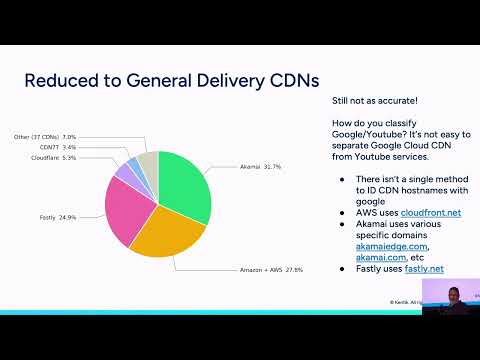
- What: Since 2023: Stackpath exited, Lumen's CDN was dismantled, and Edgio went Chapter 11 (AS22822 dark), with roughly 15% market share mostly absorbed by Akamai. Content delivery is commoditized (transit price pressure, no differentiation, hyperscaler bundles); survivors are re-tooling into edge compute/GPU platforms — the deck maps Cloudflare, Akamai, Fastly, and GCore product timelines (Workers → containers → inference; Akamai's Linode/Ondat/Geko/NVIDIA Blackwell), with the strategic asymmetry that CDNs can't match hyperscaler capital but pay zero egress. Live events: mega-streams (72.5M concurrent, T20 World Cup) were handled fine; the Jake Paul–Mike Tyson failure (60M streams, 2.5–3× normal peak) was not the network — interconnect and cache capacity had headroom, root cause suspected on the streaming/replication side, no Netflix postmortem. The AI surprise: on a large US SP, video is Tb/s while AI in August 2025 measured in hundreds of Mb/s (~1.5 Gb/s in 2026 samples) — the exec-level panic is hype-cycle artifact, not operational concern; inference is served largely via Cloudflare/Google (Anthropic's $1.8B/7yr Akamai deal noted), and the unknown is agent-driven traffic directionality (per the Schaeffer NANOG keynote), which is not yet visible in flow data.
- How: Kentik OTT mapping (DNS queries joined with flow data) plus flow-based unique-destination-IP counts as a user proxy.
- Where applicable: Industry-level perspective grounded in Kentik's customer visibility (US-weighted). Best used to calibrate capacity-planning and AI-traffic assumptions.